
Brief Summary
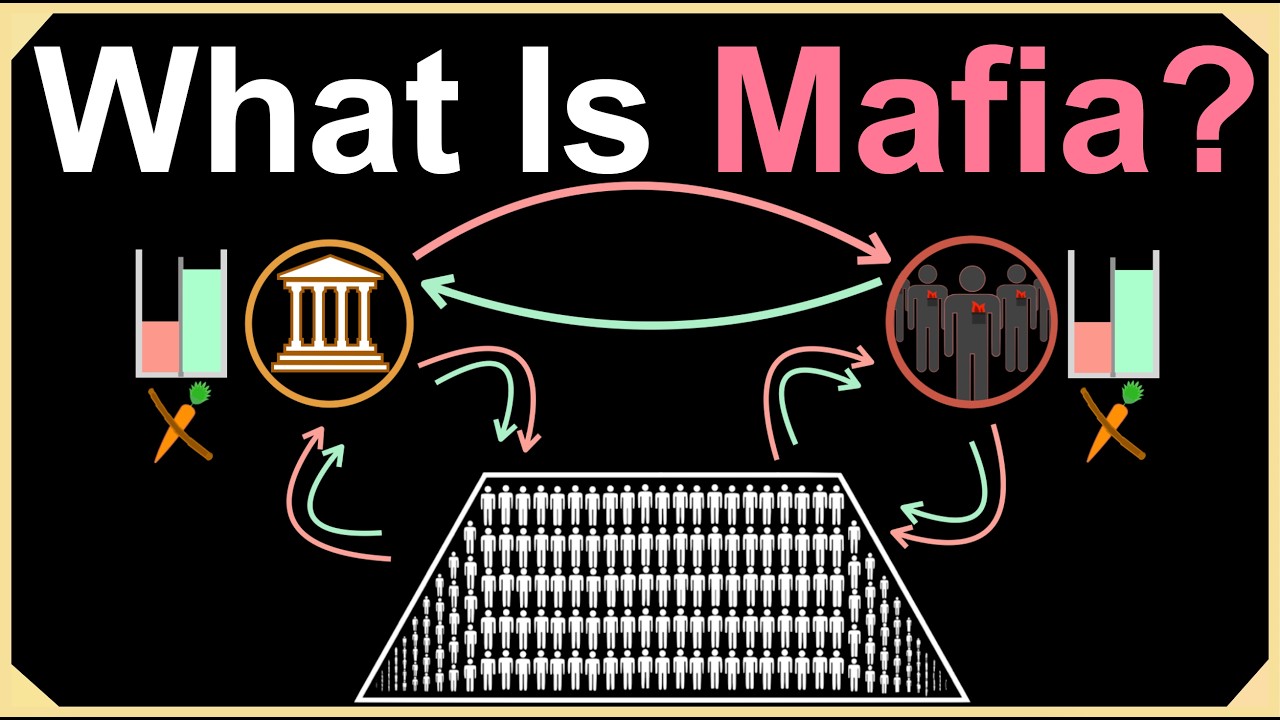
The video explores the mafia phenomenon through various theories including Gayatana Mosca's work on the organized minority ruling over the disorganized majority, the dynamics of control systems, and the implications these have on societal structures. Key points include the nature of mafia control, the interplay between the mafia and the state, and how societal responses shape these interactions.
- Mosca's Law states that an organized minority will always dominate a disorganized majority.
- The perception of the mafia as a control mechanism reflects a balance of power that influences societal governance.
Intro & 3 Model Overview
The video introduces the concept of the mafia, attributed to Gayatana Mosca, and outlines an analysis of the mafia using Stafford Beer's viable system model, Mancur Olson's stationary bandit model, and Bertrand de Jouvenel's high-low-middle mechanism. The focus is on control systems and societal regulation, emphasizing the mafia's role as a case study for these theories. The mafia's general phenomenon exists in various societies at different stages of development, serving as stationary bandits which foster societal development through security and control.
Mosca's Law: The Rulers & The Ruled
Mosca's Law posits that the disorganized majority is governed by an organized minority. He emphasizes that throughout history, two social classes exist: the ruling and the ruled. The ruling class monopolizes power and enjoys its privileges, while the ruled class, more numerous but disorganized, is controlled through both legal and violent means. This sets the foundation for understanding the mafia's operations as a means of coercive force against the disorganized populace, which ultimately undermines the state’s monopoly on violence.
Metalanguage of the Mafia
The phrase "metalanguage of the mafia" refers to the conduct and code under which mafia entities operate, distinguishing their internal processes from state functions. The mafia promotes revenge as a means of restoring personal honor, leading to self-regulation within their ranks, and ensuring loyalty among members. This reliance on an internal code of conduct creates a barrier to state interventions in cases of mafia-organized criminal actions, thus reinforcing the mafia's influence over the public.
The Mafia as an Inter-facial Parasitic Layer
The mafia is characterized as a parasitic layer within society, providing certain services while extracting resources. This relationship illustrates a system where the mafia protects citizens from more chaotic criminal elements in return for tax-like payments, making their role seem beneficial despite its exploitative nature. The mafia thrives in environments where state authority is weak, allowing it to establish a coercive presence that challenges traditional state power.
Pareto's Classification of Residues
Referencing Vilfredo Pareto, the video discusses how societal dynamics can revert to a reliance on honor and vengeance in underdeveloped or chaotic regions. Pareto's classification highlights that societal structures, including the mafia, often share psychogenic traits, drawing on patterns of personal integrity and honor-based justice. This classification elucidates the underlying motivations and social dynamics prevalent in mafia activity, especially in contexts where state mechanisms are inadequate.
Entropic Revenge Spirals
The concept of "entropic revenge spirals" captures the continuous cycle of violence characteristic of mafia culture, where personal vendetta leads to escalating conflicts. The video illustrates how violence can yield more violence, complicating social dynamics and leading to a pathological culture of respect driven by fear and retaliation. Such spirals perpetuate a cycle of instability and lawlessness that inhibits societal development.
Pathological Respect Culture
Pathological respect culture is marked by an emphasis on honor and avoiding perceived disrespect. Individuals strive to defend their honor through violence or aggression, creating an environment where minor offenses can escalate into serious conflicts. This cultural framework is especially evident in societies with weak governmental systems, leading to widespread violence and insecurity that is cyclical in nature.
Environmental Dependency
The strength of the mafia is heavily reliant on environmental conditions, specifically the robustness of state institutions. Weak states foster environments where mafia influence thrives, while stronger states can absorb or dismantle organized crime networks. The video posits that the presence of the mafia is indicative of underlying failures in state governance and public trust.
Code of Silence Omerta
Omertà, the mafia's code of silence, serves to maintain the organization's power by discouraging cooperation with state authorities. This culture of silence is reinforced by social norms that perceive seeking official justice as dishonorable. This code effectively prevents the reporting of crimes, contributing to the mafia's stronghold over community governance and its challenge to state authority.
Olson's Stationary Bandit
Mancur Olson's stationary bandit model explains how organized entities, like the mafia, stabilize environments by offering protection and security in exchange for taxation. As these entities exert power, they may engage in governance, balancing their extraction strategies against community needs. Olson's perspective underscores the mafia's dual role as both predator and protector within societal constructs.
Spirit of Mafia
The "spirit of the mafia" reflects cultural nuances surrounding honor, crime, and familial bonds that foster loyalty among members. This spirit exacerbates issues like vendetta and retribution, creating both a community cohesion and a cycle of violence. It serves as a model for understanding the collective behaviors that enable mafia persistence, representing socio-cultural phenomena that thrive in lieu of effective state control.
Mosca's Law Once Again
Mosca's Law reiterates the theme that organized minorities dominate disorganized majorities through manipulation and control. In this context, the mafia exemplifies how minority groups can exert influence and power dynamics over larger populations, using a combination of coercion and social structures to maintain dominance and control within society.
Jouvenel's High-Low Middle Mechanism
Juvenal's framework discusses how the organized higher classes can align with lower criminal elements to suppress the productive middle class, which poses a threat to the established order. This alliance serves to maintain control over societal structures, illustrating the mafia's utility to the elite as they navigate power balances, often at the expense of broader societal welfare.
Cybernetic Steering & The Normal Distribution
The mafia's operational strategies can be conceptualized through cybernetic models that reflect how information and resource flows are maintained within power dynamics. This includes understanding how normal distributions of influence and control can shift, allowing the mafia to adapt and survive. By navigating complexities in social interactions, mafia entities can sustain their influence even in changing environments.
Jouvenel's High-Low Alliance
This chapter elaborates on the beneficial arrangements between the ruling class and mafia elements, wherein both parties utilize each other to maintain subjugation over the middle classes. The alliance underlines the mutual dependence and transactional relationships facilitated by power dynamics that ultimately shape societal structures.
Public's Moral Outrage Reservoir
The concept of the public's moral outrage reservoir functions as a regulatory system that shapes interactions between the state and mafia. As public outrage accumulates from mafia activities, it can push the state to act against these entities, ensuring a balance of power. This highlights the importance of public perception in maintaining or disrupting the social order between crime and governance.
Neutralizing Public Outrage
The video discusses various mechanisms employed to neutralize public outrage directed toward the mafia, including media narratives and distraction techniques. By controlling dialogue and managing public sentiment, both mafia and state actors can circumvent significant backlash and maintain their respective powers, shaping societal stability.
Over Criminality & Suffering
Over-criminality occurs when the balance between state and mafia control falters, leading to widespread suffering among the populace. The breakdown of order allows both entities to extract excessive resources from individuals, placing immense pressure on communities already burdened by systemic inequalities.
State's Legitimacy
The legitimacy of the state is explored concerning its handling of organized crime. The tension between maintaining authority while acknowledging mafia power highlights the fragility of state control, as any perceived weaknesses can enhance criminal influence, leading to delegitimization of state power in the eyes of the public.
Mafia Viable System Model
The mafia can be viewed through the lens of the viable system model, demonstrating how it functions as an organizational entity with clear roles and leadership structures. This model offers insights into how the mafia maintains its operations and adapts in response to challenges posed by state governance or rival factions.
Risk Management
The mafia's operations involve intricate risk management strategies that help avoid state detection while continuing extortion and criminal activities. By balancing visibility with control, the mafia can operate efficiently while mitigating risks tied to law enforcement responses.
Mafias As Meritocracies
Mafia organizations operate with meritocratic principles, rewarding skilled and effective members who navigate the criminal landscape successfully. This dynamic fosters a competitive environment that enhances the mafia's resilience while cultivating a pool of capable individuals within its ranks.
2 Types of Instrumentality
Two instrumentalities are discussed: the direct coercive power of the mafia and the more subtle influence it holds over political structures. Understanding both allows for a clearer picture of how the mafia functions within societal systems, often orchestrating relationships that benefit both its members and higher political entities.
The Mafia Game: The Setup
The mafia's approach to "the game" of organized crime involves a setup where legitimacy is carefully crafted to coexist with their illicit activities. This game requires strategic planning and an understanding of both societal dynamics and state regulations to navigate the intricate web of crime and governance.
The Mafia & The State
The relationship between the mafia and the state reflects a complex dynamic of power, where both entities may rely on one another for survival. The interplay highlights how states can become entangled with criminal organizations, prompting a reevaluation of governance and authority.
Ternary Viable System
A ternary viable system model describes how different components within the mafia and state systems interact and maintain balance. This model underlines the importance of interconnected roles that sustain both organizations as they adapt to societal changes and challenges.
Brigandage
Brigandage is examined as an ancient form of organized crime that has evolved into modern mafia structures. The historical context emphasizes how these groups leveraged power imbalances and social conditions to assert control and influence in society, serving as precursors to contemporary mafia practices.
Brigandage & The High-Low Middle Mechanism
This chapter discusses how brigand groups historically formed alliances with the elite to maintain control over populations. Such relationships highlight the enduring patterns of cooperation between organized criminals and state actors, reinforcing power dynamics that persist into the present.
Off-the-record information
The importance of off-the-record information in mafia operations is explored, illustrating how these informal channels enable the mafia to maintain secrecy and conduct business without exposure. This dynamic allows the organization to function effectively while minimizing state intervention.
The Remainder Because I Forgot To Keep Writing Timestamps
This concluding section highlights how the themes presented throughout the video intersect and reinforce the overarching analysis of the mafia as both a societal necessity and a disruptive force in governance. It serves as a reminder of the complexities inherent in the relationships between organized crime and state authority.

