
Brief Summary
The video explores the profound question of why the night sky appears black, despite the vast number of stars spread throughout the universe. It discusses the historical context of this mystery, from early astronomers like Thomas Digges and Johannes Kepler to modern science’s understanding of the expanding universe and light's limitations. Key takeaways include:
- The universe is finite in age, which implies a limit to the observable light.
- The expansion of the universe stretches light waves, making some wavelengths invisible.
- Cosmic events have resulted in a black sky that captures the complexity of time, history, and the nature of cosmic observation.
The Black Night Sky
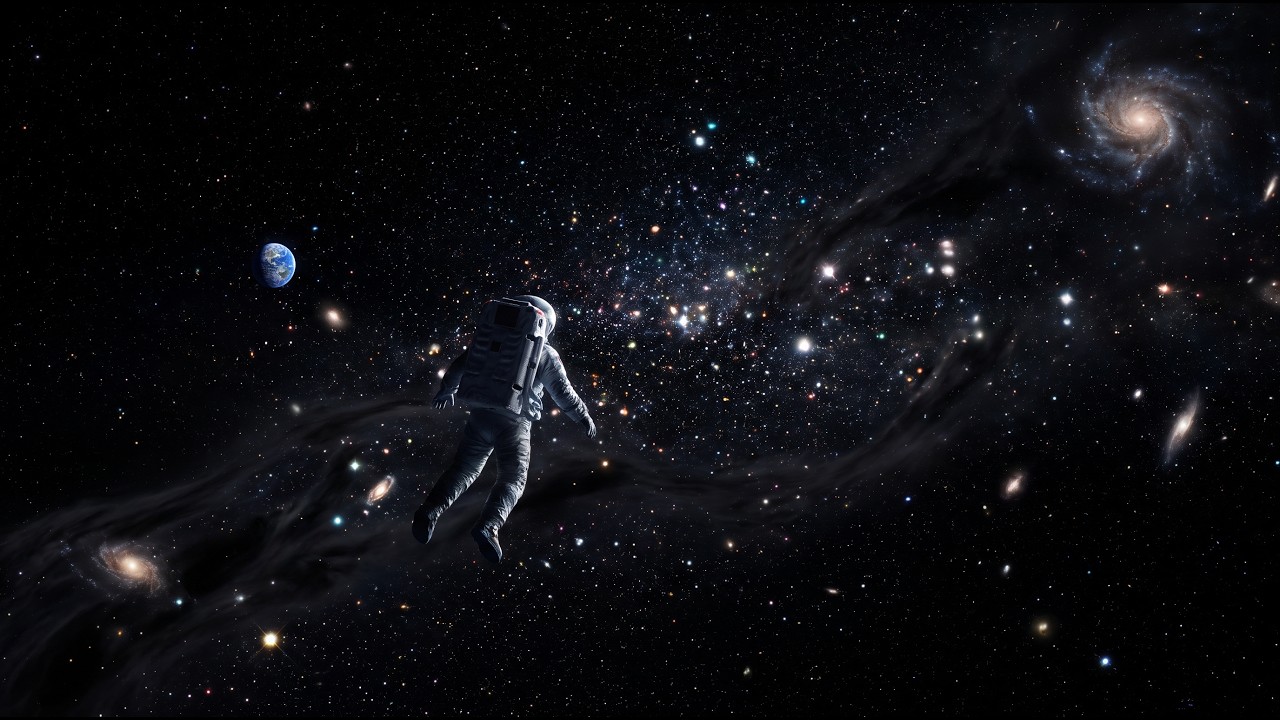
The video begins by depicting the serene beauty of a star-filled night sky far from city lights, emphasizing the overwhelming darkness that surrounds the stars. This darkness raises an essential question: Why is the universe, filled with galaxies and stars, still black? For centuries, this question has perplexed scientists and philosophers.
The Courageous Hypothesis of Digges
In the late 16th century, astronomer Thomas Digges challenged the traditional view of a star-studded celestial sphere. He proposed that stars are scattered infinitely in all directions, suggesting an infinite universe. However, he posed a new mystery: if the stars are infinite and uniformly distributed, why don't we see all of them at once in bright daylight?
Kepler's Insight on Darkness
A century later, Johannes Kepler built on Digges' idea, formulating the paradox that if the universe were infinite and homogeneous, any line of sight should intersect with a star, making the night sky bright. His argument suggested that because the sky is dark, the universe must be finite with boundaries.
Attempts to Explain the Darkness
In the 18th century, Jean Philippe Loys de Cheseaux introduced the idea of a light-absorbing medium in space that could diminish the light from distant stars. However, this seemed insufficient since thermodynamics indicated that such absorption would eventually radiate back light.
Olbers' Paradox
Heinrich Wilhelm Olbers further refined the question of why the night sky is dark. His paradox postulated that if the universe were infinite, static, and eternal, the sky should be uniformly bright. The problem lay in the assumption that there was an infinite amount of light reaching us.
The Involvement of Edgar Allan Poe
Edgar Allan Poe contributed to this discourse with his work "Eureka," suggesting that the light from distant stars may simply not have reached us yet due to the finite speed of light, hinting at the universe's ultimate age.
The Age of the Universe
The concept of a finite universe was solidified with Edwin Hubble’s discovery in the 20th century that galaxies are moving away from us, signifying an expanding universe. This led to the Big Bang theory, which postulates an age of approximately 13.8 billion years, restricting our view to what can be reached within this time.
The Redshift Phenomenon
Hubble's observations also revealed that light from distant galaxies is redshifted, meaning it stretches over time and can become invisible, contributing to the darkness of the night sky.
Discovery of Cosmic Microwave Background Radiation
The 1964 discovery of cosmic microwave background radiation by Arno Penzias and Robert Wilson revealed that the universe indeed glows, but not in visible light. This background radiation reflects the early universe's heat and is uniform across the sky.
Mapping the Universe's History
Technological advancements in the 1990s provided detailed maps of cosmic microwaves, uncovering temperature fluctuations that hinted at the seeds of galaxies, offering deeper insights into the universe's structure and evolution.
The Black Sky's Secrets
The apparent blackness of the night sky is attributed to several factors: the finite age of the universe, the expansion of space, the ephemeral nature of stars, and the limited sensitivity of human eyesight. These insights together reveal the complexities and the rich history hidden within the darkness of the night sky.
The Future of Cosmic Observation
As the universe continues to expand, future observers will notice an even darker sky, where distant galaxies will eventually drift beyond our reach, leaving only our local stellar neighborhoods visible in the night sky. This change will obscure historical cosmic knowledge and shift the perspective of future civilizations.
Concluding Reflections
Ultimately, viewers are encouraged to appreciate the depth of the night sky. It serves as a reminder of the universe's vastness, the passage of time, and the interconnectedness of space and knowledge. The black sky embodies not emptiness but the extensive narrative of existence and the wonders yet to be explored.

