
Brief Summary
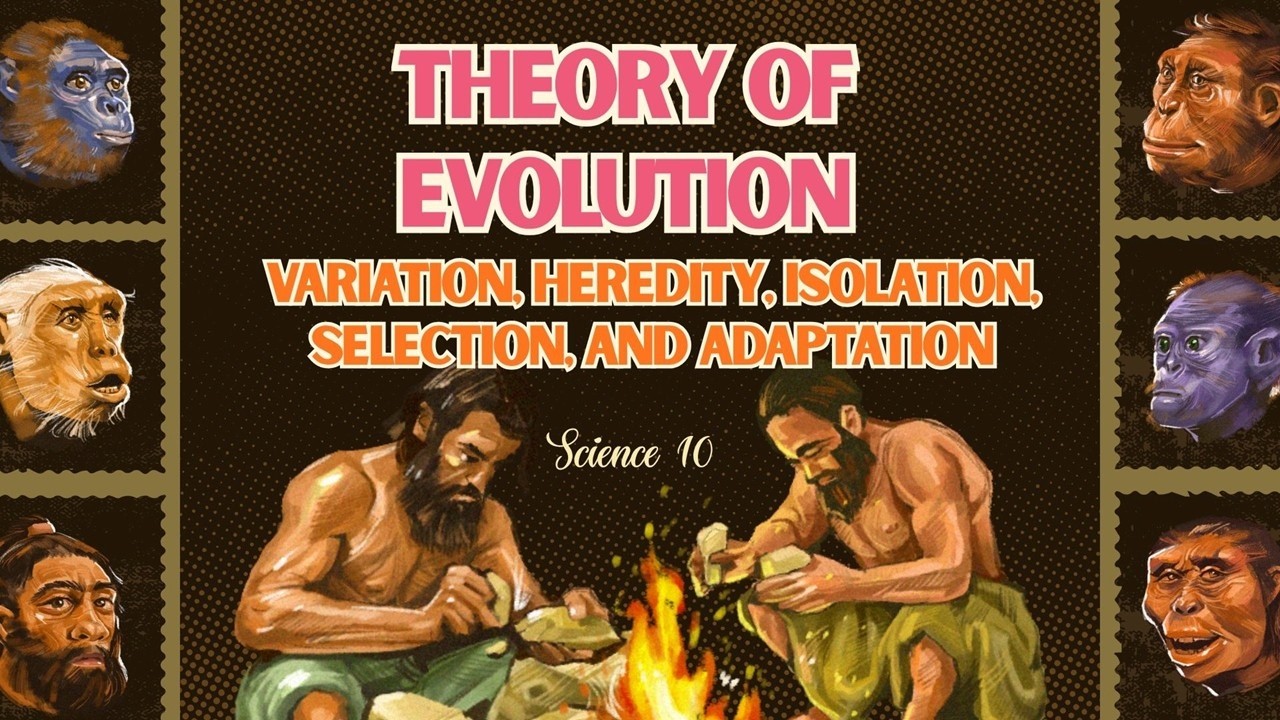
This lesson discusses key concepts in the theory of evolution, highlighting terms such as variation, heredity, isolation, selection, and adaptation. Understanding these terms is crucial for explaining how evolution occurs and the significance of biodiversity.
- Variation refers to differences among individuals in a species.
- Heredity is the passing of traits from parents to offspring, influencing the evolution of species.
- Isolation can lead to the development of new species when populations are separated.
- Natural selection is a mechanism by which individuals with beneficial traits are more likely to survive and reproduce.
- Adaptation involves traits that enhance an organism's ability to survive in its environment.
Introduction to Evolution Concepts
The lesson begins by welcoming tenth-grade students and introducing the topic of evolution. The presenter outlines the learning objectives, which include explaining basic concepts of evolution and discussing the importance of variation, heredity, isolation, selection, and adaptation in the evolutionary process. The need for group discussions and collaboration among students is emphasized.
Understanding Variation
The concept of variation is explained as the differences among individuals of the same species, which are crucial for survival and evolution. Examples include differences in eye color and fur among animals. Variation allows some individuals to thrive under changing environmental conditions, demonstrating that diversity is essential for the survival of species.
The Role of Heredity
Heredity is described as the passing of traits from parents to their offspring through genes. Children usually resemble their parents due to these inherited traits. The video provides examples of how certain traits can increase the chances of survival for future generations, emphasizing that without heredity, beneficial traits would not persist across generations.
Isolation and Evolution
Isolation occurs when groups of the same species are separated and unable to reproduce with one another, potentially leading to the development of new species. Geographic isolation and reproductive isolation are discussed, using examples like land barriers preventing different groups from mating. Over time, isolated populations may evolve into distinct species due to differing environmental pressures.
Natural Selection Explained
Natural selection is highlighted as the process through which organisms with advantageous traits are more likely to survive and reproduce. The video uses grasshoppers as an example, showing how their coloration affects their survival based on their environment. Natural selection shapes species over time, leading to adaptations that enhance survival rates.
Adaptation in Organisms
Adaptation is defined as a characteristic that helps an organism survive and reproduce in its environment. Examples include polar bears with thick fur for cold climates and cacti with water-storing stems for arid regions. The presenter notes that these adaptations are crucial for the survival of species and highlight how environmental changes trigger gradual adaptations over many generations.

