
Brief Summary
The video discusses the hypothesis of consciousness' evolution through language as proposed by Friedrich Nietzsche and Julian Jaynes. It emphasizes that consciousness developed primarily for communication among humans and was influenced heavily by social structures. Jaynes’ theory suggests that early civilizations operated under a "bicameral mind," where individuals experienced auditory hallucinations seen as commands from gods instead of conscious self-reflection.
- Nietzsche claimed consciousness was a social tool for communication.
- Jaynes theorized that early humans lacked true consciousness, relying on divine commands instead.
Nietzsche’s Hypothesis on Consciousness
In 1886, Friedrich Nietzsche posited that consciousness developed under the necessity for communication, primarily among humans in hierarchical structures. He suggested it arose as a tool for interaction, particularly for those in power to express their needs and emotions. The concept of consciousness may not have been relevant for individuals leading solitary lives, like hermits or wild animals, as their existence did not require social exchanges that would necessitate such awareness.
Jaynes’ Bicameral Mind Theory
Julian Jaynes expanded upon Nietzsche’s ideas by presenting the "bicameral mind" concept, where individuals prior to the first millennium BC operated without self-awareness as we understand it today. He argued that they relied on auditory hallucinations perceived as divine communications to direct their actions. These experiences emerged from the right brain's spatial awareness portion, sending commands to the left-brain analytical areas.
Consciousness vs. Reasoning
Both Nietzsche and Jaynes noted that consciousness should not be conflated with reasoning and that many thoughts remained unconscious. Jaynes pointed out that consciousness is not essential for learning and argued against the notion that consciousness is simply a record of experience. Instead, he emphasized that language fundamentally shaped and created consciousness rather than the opposite.
The Development of Consciousness Post-Language
Jaynes asserted that consciousness emerged from language use as a communication tool. The progression of linguistic structures significantly influenced how individuals began to perceive themselves and their thoughts. Language provided a framework that enabled the evolution of self-consciousness, where symbols and words shaped the understanding of one’s own existence and reality.
Julian Jaynes' Life and Work
Born in 1920, Julian Jaynes pursued psychology and became a conscientious objector during WWII, leading to his imprisonment. Afterward, he continued studying consciousness. His notable research was compiled in his 1976 book, "The Origins of Consciousness in the Breakdown of the Bicameral Mind," which faced significant criticism but garnered worldwide interest in Jaynes' ideas.
Speculative Anthropology and The Iliad
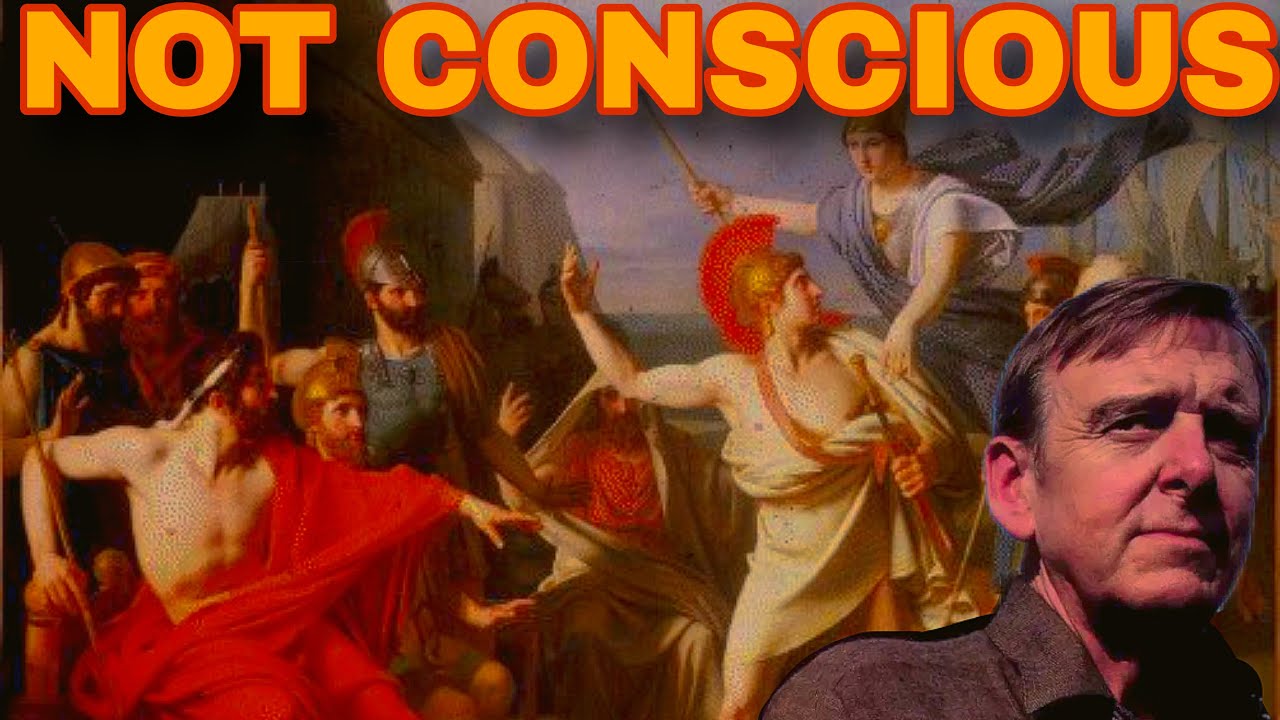
The Iliad of Homer serves as a crucial text for examining the consciousness of ancient societies. Jaynes pointed out that the Iliad portrays characters lacking internal identity and consciousness. Terms in the poem referenced physical actions rather than mental states, indicating a bicameral way of existing where decisions were guided by divine command rather than personal reflection.
Concepts of the Gods in The Iliad
Jaynes highlighted that the Greeks did not view their gods as creators but as authoritative figures commanding human action. In the Iliad, gods led and inspired the characters, reflecting a lack of personal agency. The narratives suggest that these interventions by gods superseded conscious thought, as characters often attributed their decisions to divine influence or commands.
Auditory Hallucinations and Modern Interpretations
Jaynes’ theory suggests that auditory hallucinations were prevalent in bicameral societies, serving as instructions from gods. He correlated the experiences of modern schizophrenics, who often hear voices, to those of ancient humans. The expectation was that as consciousness developed, these commanded voices were no longer needed, thus altering the perception of reality and agency.
Neurological Basis of Consciousness
The video discusses the neurological underpinnings of the bicameral mind theory, focusing on how the brain’s left hemisphere governs language while the right assesses context. Jaynes proposed that auditory hallucinations, experienced as commands, could have originated from right hemisphere areas that shared functions with the left hemisphere but were not actively engaged in conscious speech.
Evolutionary Implications of Bicameralism
Jaynes argues that the structures of the brain adapted over time, transitioning away from reliance on auditory commands as societies evolved. Stress triggers that once prompted auditory hallucinations in critical situations diminished as self-consciousness emerged, leading to a need for introspection and reasoning absent in earlier bicameral societies.
Future Explorations of Consciousness
The video concludes with a preview of upcoming discussions on how bicameralism influenced early civilizations, including societal structures and the development of rituals. Jaynes’ hypothesis presents a fascinating framework for understanding the dawn of human consciousness and its implications on governance, morality, and self-awareness in the context of history.

