
Brief Summary
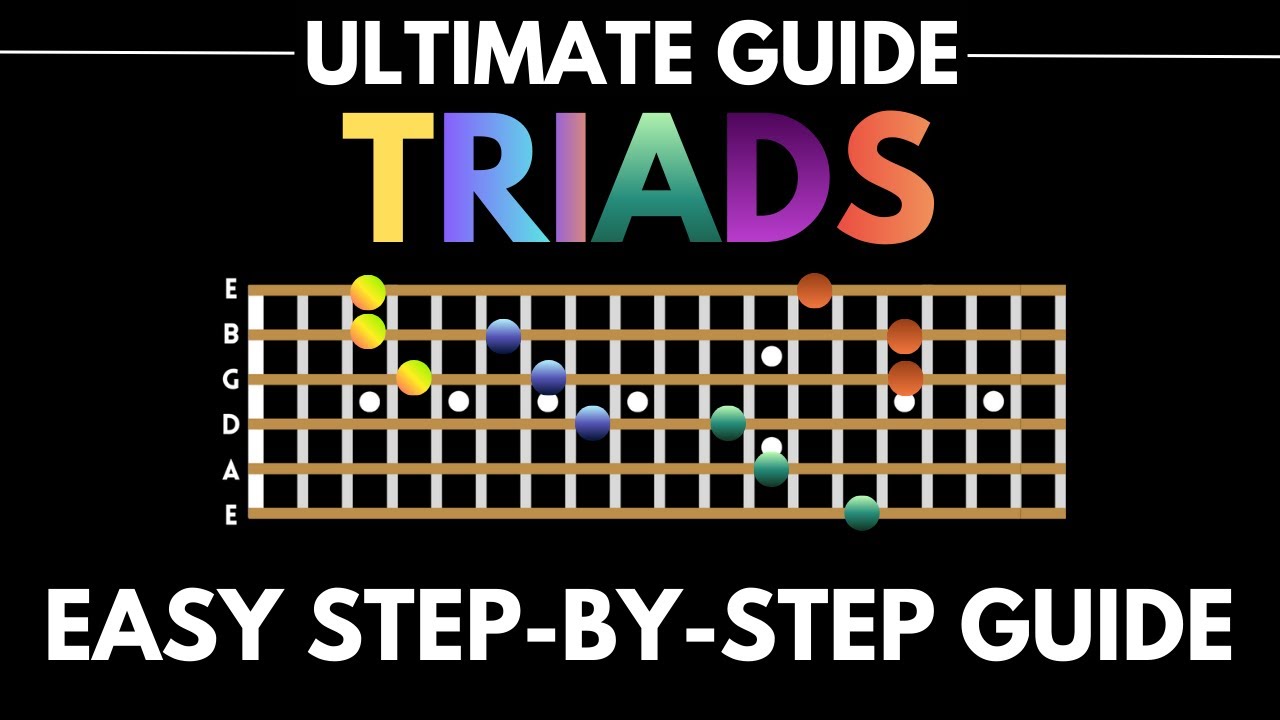
The video provides a comprehensive guide on triads, covering their shapes, inversions, and practical applications for both rhythm and lead guitar playing. Key points include:
- Triads are three-note chords essential for various musical contexts.
- Understanding inversions and their usage enhances the smoothness of chord transitions.
- The video introduces a method to memorize triad shapes across the fretboard and their application in real-time music performance.
Intro to Triads
Triads are fundamental three-note chords broken down into 12 shapes across the fretboard, organized into four string zones. Musicians can learn three simple shapes per zone, allowing for easy memorization and usage in playing.
What are Triads? And why do I Need Them?
Triads, consisting of three notes, can form various progressions and significantly enhance rhythm playing and targeting chord tones during solos. For example, a G major triad includes the notes G, B, and D, the first, third, and fifth of the G major scale. Triad shapes can also be organized in different orders, referred to as inversions, affecting their sound and usefulness in play.
What Are Inversions?
Inversions are created by changing the order of the notes in a triad. A G major triad in root position has G as the lowest note, while the first inversion places B at the bottom, and the second has D. This concept applies to more complex chords too, such as seventh chords, where additional inversions may be introduced.
Root Position Triads
Root position refers to the arrangement where the root note is the lowest in the chord. For a G major triad, playing the notes G, B, and D in that order represents the root position, providing a fundamental understanding of how triads are constructed.
1st Inversion Triads
The first inversion of triads occurs when the root note is shifted to the top of the chord. For example, in a G major triad, playing the notes B, D, and G forms the first inversion, changing its tonal quality while still maintaining the chord.
2nd Inversion Triads
The second inversion occurs when the third of a triad is the lowest note. In the case of G major, this would be D, followed by G and B, creating a different sound and expanding the harmonic possibilities available for performance.
3rd Inversion
Third inversion is related to four-note chords, such as seventh chords, where the seventh note is the lowest. Understanding this helps musicians navigate when playing more complex chord structures.
Slash Chords
Slash chords, indicated by a chord followed by a slash and a note (e.g., G/B), show that the triad is played with a different lowest note. This highlights how inversions can be expressed in sheet music and how they can affect tonal outcomes.
Summary of Inversions
The segment summarizes how inversions change the lowest note in a triad, allowing musicians to explore different soundscapes while still retaining the essential notes of the chord. The choice of which inversion to use depends on musical context and desired smoothness in transitions between chords.
When to Use Different Inversions?
Choosing between different inversions hinges on the musical context. Using one inversion over another can lead to smoother chord transitions, minimizing the distance that each note must move to reach the next chord change.
Inversions Example (Voice Leading)
Demonstrating voice leading, the video provides examples of how using the appropriate inversions enhances the flow between chord changes, making transitions sound more cohesive.
The 4 Zone Triad Method
To teach triad shapes, the fretboard is divided into four string sets, each containing three triad shapes. This breakdown provides a structured approach to mastering all 12 essential triad shapes.
Zone 1 Triads (GBE Strings)
The video details the triad shapes available in the first string set, demonstrating their placement and allowing learners to focus and memorize these shapes effectively.
Zone 2 Triads (DGB Strings)
Similar to Zone 1, this section presents the triad shapes located on the second string set, highlighting their unique characteristics and how to play them.
Zone 3 Triads (ADG Strings)
Zone 3 continues the breakdown, introducing additional triad shapes on the third string set. Emphasis is placed on memorization and shifting between these shapes.
Zone 4 Triads (EAD Strings)
The final string set consists of the fourth zone's triad shapes, rounding out the comprehensive approach to learning all triad shapes on the fretboard.
Time to Memorize!
Now that the triad shapes are introduced, the video encourages viewers to memorize each shape, focusing on one string set at a time to reinforce learning and improve fluency in playing.
Root Note Triad Locations
Understanding where to locate the root note in each triad shape is essential. Knowing these locations aids in playing triads in different keys and enhances adaptability in performance.
Changing Keys
To play triads in various keys, musicians can shift all triad shapes up or down based on the root notes. However, effective real-time application involves attaching triads to any chosen root note directly.
How to Use Triads in Real Time
In applying triads during a performance, it’s best to find the nearest root note and use it to attach relevant triads. This helps musicians transition smoothly between chords during solos or songs.
Pentatonics and Triads
Pentatonic scales can serve as pathways connecting different triads. This concept helps musicians view triads as destinations within a scale, enhancing their ability to navigate the fretboard.
Chord Tone Soloing Using Triads
Focusing on chord tones while soloing makes the music more coherent. Musicians are encouraged to blend specific triads as they progress through chord changes to sound more musical.
Other Triad Chord Types? (Major - Minor - Diminished - Augmented)
The video explains that besides major triads, there are also minor, diminished, and augmented triads. Understanding these distinctions allows musicians to apply similar principles for constructing and recognizing various triad forms.
Triads For Better Rhythm Guitar
Triads play a crucial role in rhythm guitar playing. Smaller three-note voicings create space in the mix, allowing for clearer arrangements alongside other instruments, providing a more balanced sound.
Triads = More Chord Variety
Gaining mastery over triads enables musicians to explore a variety of chord progressions differently and adds versatility to their playing, facilitating richer musical expressions.
Guitar Triad Poster
A triad chart poster is available for purchase, serving as a quick reference for musicians looking to enhance their chord knowledge and memorization of triad shapes across the fretboard.

