
Brief Summary
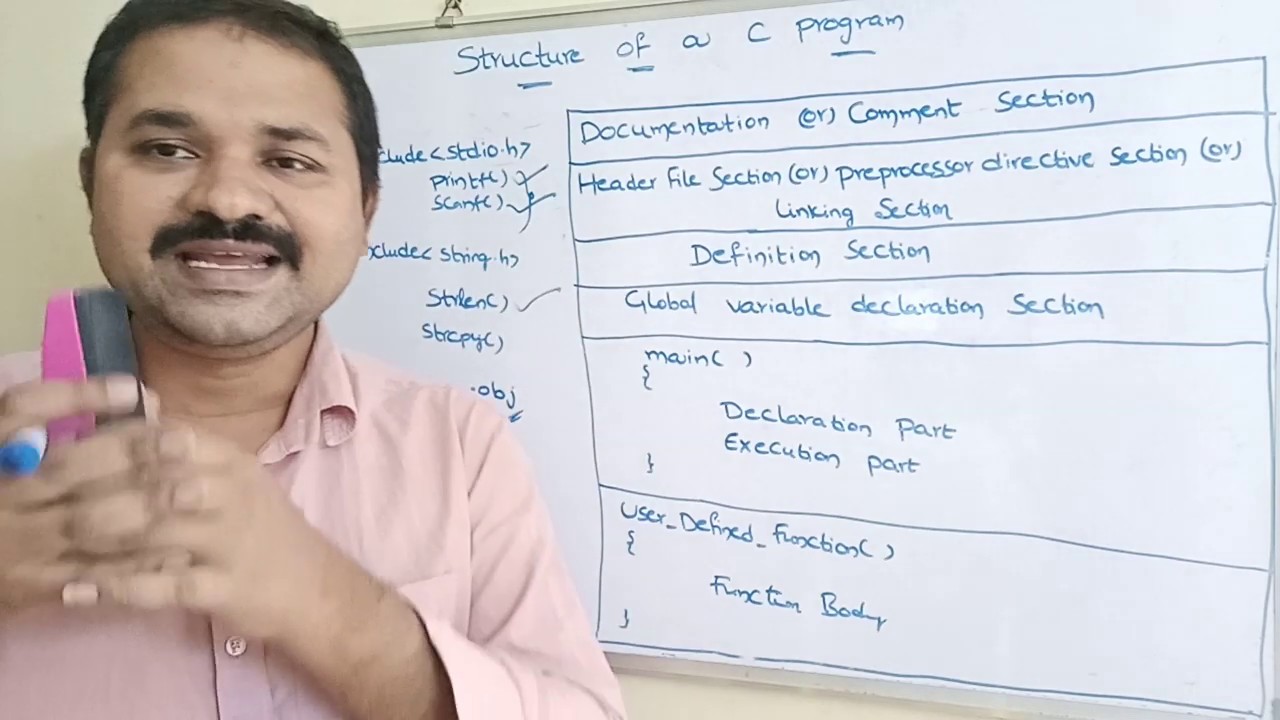
The video outlines the necessary structure of a C program, which includes specific sections essential for the program's functionality.
- The program must have a documentation section, a header file section, a definition section, a global variable declaration section, a main function, and user-defined functions.
- Each section's purpose is explained, from providing comments for clarity to linking libraries and defining variables.
Structure of a C Program
The video begins with an introduction to the fundamental structure of a software engineering (SE) program, specifically focusing on C language. It establishes that every C program must adhere to a defined structure consisting of various sections.
Documentation or Comment Section
The first section discussed is the documentation or comment section, which is essential for understanding the program's purpose. Comments explain statements in the code, providing clarity; for example, a statement like C = A + B can be elucidated with a comment indicating that it adds A and B and stores the result in C. Comments are non-executable and begin with /* and end with */, aiding programmers without affecting compilation.
Header File Section or Preprocessor Directives
The second section is the header file section, also referred to as the preprocessor directive section. Header files contain collections of library functions. For instance, #include <stdio.h> includes standard I/O functions. The preprocessor directives are processed before compilation to ensure that functions used in the code, such as printf() or scanf(), are recognized by the compiler. Proper linking is necessary to allow the main program to access these functions.
Definition Section
Next, the definition section is crucial for defining macros, which serve as symbolic constants. An example provided is defining PI as 3.14. This constant cannot be altered throughout the program, ensuring stability. The syntax used to define a macro is typically #define MACRONAME value, and these definitions help maintain consistent values across the program.
Global Variable Declaration Section
The video then addresses the global variable declaration section, which includes local and global variables. Local variables exist within a specific function, while global variables can be accessed throughout the entire program. Declaring a global variable above the main function allows it to be used across various functions, enhancing its accessibility.
Main Function Definition
Every C program must have at least one function, which is the main function. The execution of a C program starts from this function. The main function includes a declaration part for variables and an execution part that contains the operational logic of the program. This section highlights how statements are processed within the function, detailing input and output operations.
User Defined Functions
Finally, user-defined functions are discussed. These functions are created by the user and begin with a similar syntax to the main function but do not require a semicolon at the end of the function declaration. Users can define multiple functions based on their program's needs, allowing flexibility in coding for operations such as arithmetic calculations.
The video concludes by reinforcing the necessity of following this structure in any C program, summarising each of the functions and sections discussed.

