
Brief Summary
In this live session, the speaker discusses the importance of funnels in marketing, emphasizing that understanding funnels is crucial for success in the digital marketing realm. He shares insights on how every business operates within a funnel structure and outlines various types of funnels, their components, and strategies to enhance conversions.
- Importance of learning about funnels for marketing success.
- Overview of funnel types and how to adapt them to individual business needs.
Introduction to Funnels and Marketing
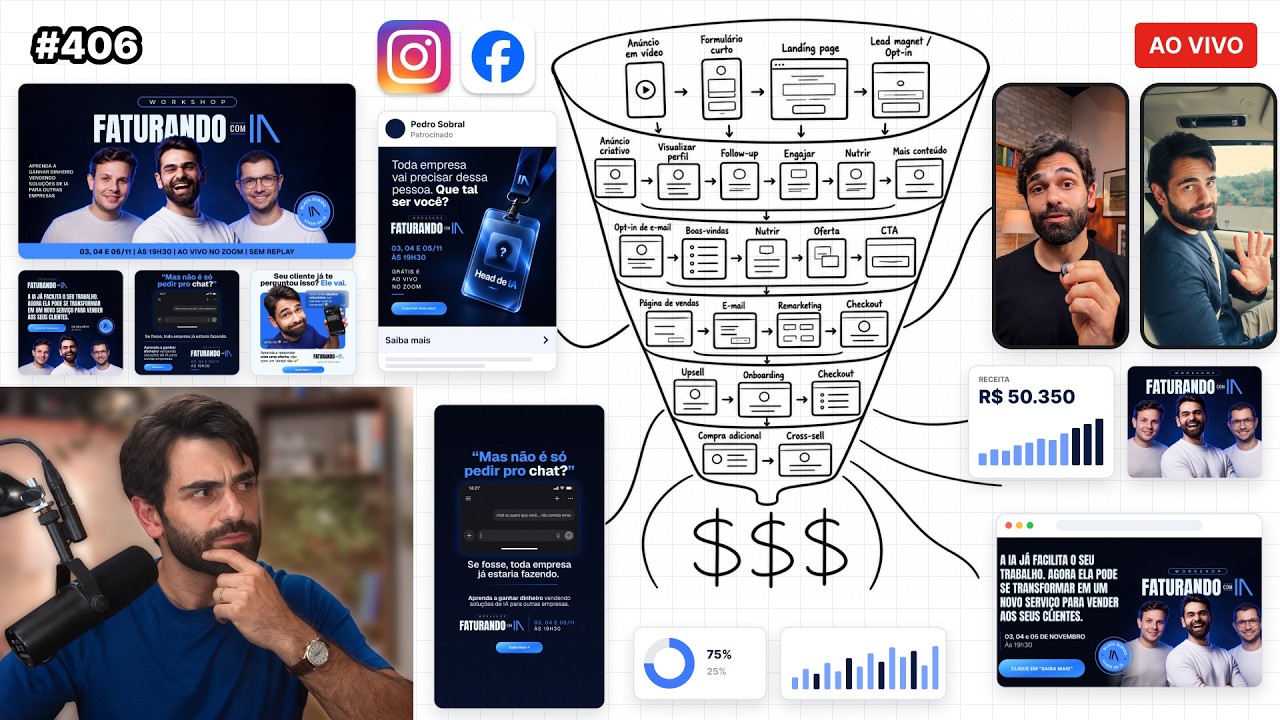
The speaker welcomes viewers to the session and announces that this is the 406th live broadcast. He emphasizes that understanding funnels is essential for anyone involved in marketing. He outlines the purpose of the session and highlights that he will be using visual aids to explain funnel concepts, recognizing his artistic limitations but acknowledging their necessity in conveying the ideas effectively.
Understanding Funil Structures
He explains the basic structure of a funnel, describing it as the process a potential customer experiences from discovering a business to making a purchase. The funnel typically consists of three main stages: attraction (where potential customers become aware of the business), consideration (where they evaluate the options), and conversion (the actual purchase). The speaker presents visuals to illustrate this concept.
Key Principles of Funnels
In this section, the speaker shares his beliefs about funnels based on his experience in generating over 250 million reais in revenue online. He discusses several principles: the simplest funnels yield the best results, every funnel has weaknesses that need attention, and optimizing a funnel involves identifying and improving its weakest points. He stresses that understanding the behavioral nuances of potential customers is critical.
Defining Funnel Terminology
The speaker introduces essential funnel terminology. This includes definitions of common terms such as lead (a potential customer), conversion rate, and landing page. He emphasizes the importance of clear definitions for effectively implementing and improving funnels.
Funnel Components: Lead Generation
In this chapter, he delves deeper into lead generation aspects, explaining lead qualification, lead scoring, and nurturing leads. He mentions the significance of using a Customer Relationship Management (CRM) system to manage leads and track interactions efficiently.
Commercial and Sales Processes
He discusses the commercial sales processes involved in funnels, detailing the pipeline concept, which outlines the stages a lead goes through before becoming a customer. Terms like MQL (Marketing Qualified Lead) and SQL (Sales Qualified Lead) are introduced, emphasizing the importance of these distinctions in maximizing sales efforts.
Funnel Types and Their Uses
The speaker outlines various types of funnels including lead funnels, tripwire funnels, VSLs (Video Sales Letters), and launch funnels. He provides examples of each funnel type, expounding on how they operate, their intended purposes, and how they can be integrated into marketing strategies effectively.
Metrics for Funnel Success
In this chapter, key metrics for evaluating funnel performance are highlighted. Terms like CPA (Cost Per Action), CAC (Customer Acquisition Cost), and ROAS (Return on Ad Spend) are discussed to give viewers a solid understanding of how to measure funnel effectiveness.
Conclusion and Call to Action
The session concludes with the speaker encouraging viewers to apply the concepts discussed about funnels and emphasizing that these insights are meant to empower their marketing strategies. He invites comments and encourages participation in an upcoming workshop focused on practical applications of funnel strategies.

