
Brief Summary
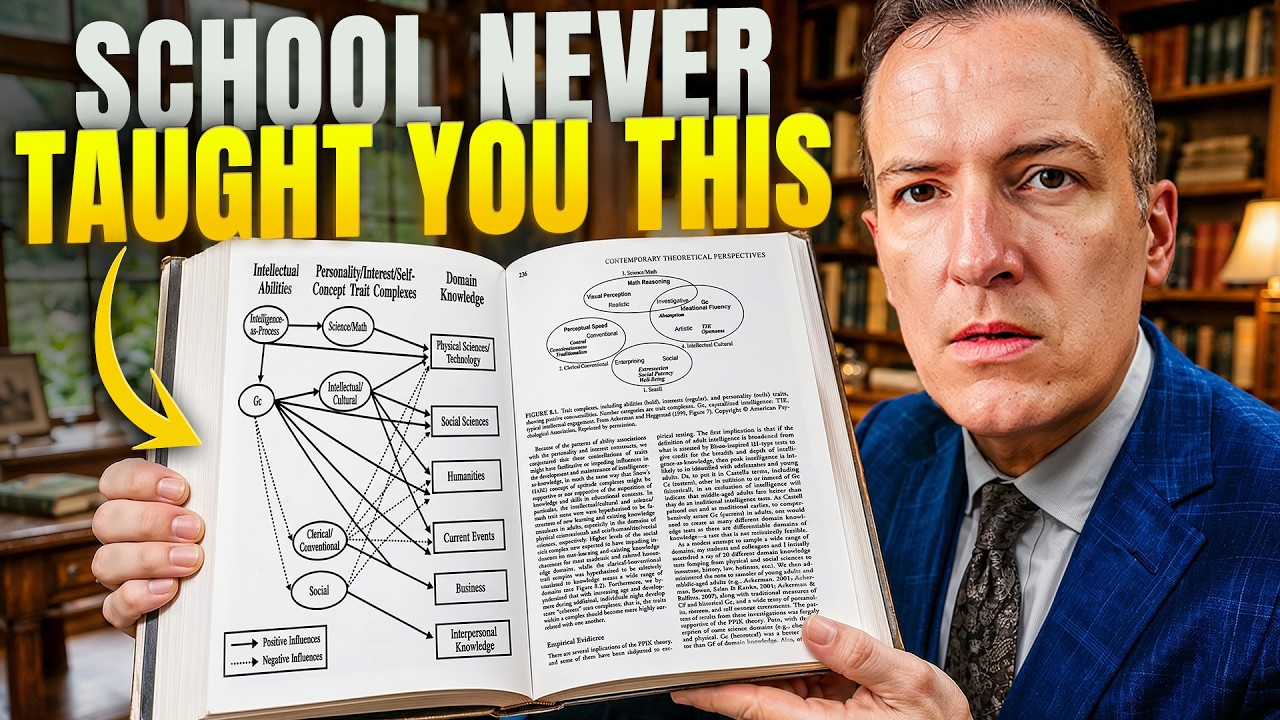
This video explores the concept of adult intelligence, highlighting that raw cognitive processing power is not the sole indicator of success over a lifetime. It introduces Philip Ackerman’s PPIK theory, which comprises four components: intelligence as process, personality, interests, and intelligence as knowledge. The video emphasizes the importance of investing one's initial cognitive ability into durable knowledge and explains how personality traits like intellectual engagement and specific interests influence this process.
- Raw cognitive processing peaks in late adolescence but can be transformed into enduring knowledge over time.
- Personality and interests significantly affect how individuals engage with their intelligence to build expertise.
The Science Behind Elite Cognitive Performance
The video starts by examining the disparity in outcomes among individuals with identical IQ scores over 30 years. It underlines the importance of understanding how top performers build their cognitive abilities over a lifetime. The discussion establishes that intelligence involves more than just raw IQ, suggesting deeper frameworks that account for the development of cognitive skills.
Intelligence-as-Process
Ackerman’s PPIK theory begins with intelligence as process, which includes fundamental cognitive skills like reasoning ability and working memory. These abilities typically peak in late adolescence and gradually decline, suggesting that raw processing power is only an initial asset. The theory posits that this capacity serves as capital to be invested in continuous learning and skill development, as seen in real-life examples where gaining practical skills can transform cognitive processes into lasting knowledge.
Personality
Personality traits, particularly intellectual engagement or the enjoyment of effortful thinking, play a critical role in determining how effectively an individual invests their cognitive abilities. Two individuals with similar intelligence may diverge considerably in their cognitive development based on their intrinsic motivations toward challenging tasks. This engagement can be nurtured and developed through habits that encourage tackling cognitively demanding challenges, thus fostering a mindset that seeks complexity rather than avoiding it.
Interests
Ackerman identifies that interests act as a guiding force in cognitive development. Two main interest patterns—investigative and artistic—are highlighted as particularly beneficial for knowledge building. The focus of pursuit can dramatically affect the level of expertise attained; those who direct their intellectual engagement toward fewer deep domains are more likely to develop significant expertise compared to those who spread their efforts thinly across many superficial interests. The interactions within interest traits can create clusters that enhance knowledge acquisition.
Intelligence-as-Knowledge
The final component of Ackerman’s framework is intelligence as knowledge, which focuses on the accumulation of depth and breadth of understanding over a lifetime. This section emphasizes that as adults age, those who effectively build their knowledge can demonstrate higher intelligence levels, even as raw processing ability declines. Examples, such as surgeon Michael DeBakey, illustrate that extensive practical knowledge can surpass the performance of individuals with higher cognitive processing abilities but less experience. Ultimately, the key takeaway is to convert raw cognitive capital into transferable knowledge through the strategic use of time and interests, thereby laying the groundwork for lifelong learning and intellectual achievement.

