
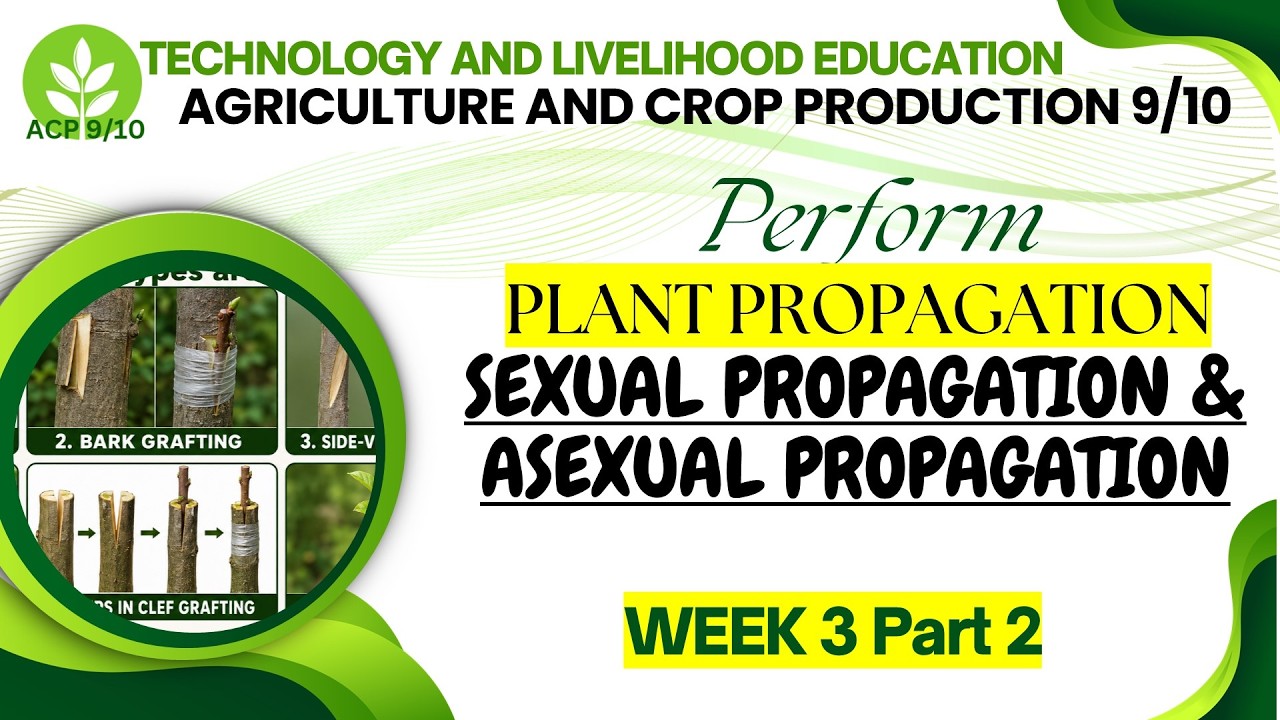
Brief Summary
This video focuses on plant propagation in technology and livelihood education, covering methods of producing new plants. Key points include:
- Two main types of plant propagation: sexual and asexual.
- Steps for direct and indirect seeding.
- Different methods of asexual propagation, including grafting, budding, layering, and cuttings.
Technology and Livelihood Education
The video introduces the concept of technology and livelihood education, setting the stage for discussions around agricultural practices, specifically focusing on plant propagation.
Agriculture Crop Production
This chapter discusses agricultural crop production, emphasizing the importance of plant propagation methods in enhancing crop yield and sustainability.
Week Three, Part Two
The video presents 'Week Three, Part Two' focusing on plant propagation, outlining its relevance to agricultural education.
Plant Propagation
Here, the topic of plant propagation is introduced. The concept entails creating new plants from seeds, cuttings, or other plant parts.
Sexual and Asexual Propagation
This section explains the two types of plant propagation: sexual, which uses seeds and spores, and asexual, which utilizes plant parts for reproducing plants.
Sexual Propagation
Sexual propagation is defined as reproducing plants using seeds and spores. It can occur through direct or indirect seeding. Direct seeding involves planting seeds directly in the soil while indirect seeding refers to germinating seeds in indoor containers before transplanting them. Specific steps for both methods are detailed, emphasizing care for seedlings.
Asexual Propagation
Asexual propagation uses vegetative parts like leaves, stems, or roots. Various methods, such as grafting, budding, layering, and cuttings, are discussed. Grafting involves joining two plant parts—the scion and rootstock—while budding uses a part of the upper plant for grafting. Layering involves rooting still-attached plant parts, and cuttings involve regenerating detached plant segments. Asexual propagation results in clones of the parent plant.
Conclusion and Group Activity
The video wraps up with a reminder of the significance of both propagation methods in agriculture and gardening, as they ensure healthy plant growth and crop production. A group activity related to planting materials is also mentioned before concluding with a call for viewer engagement.

