
Brief Summary
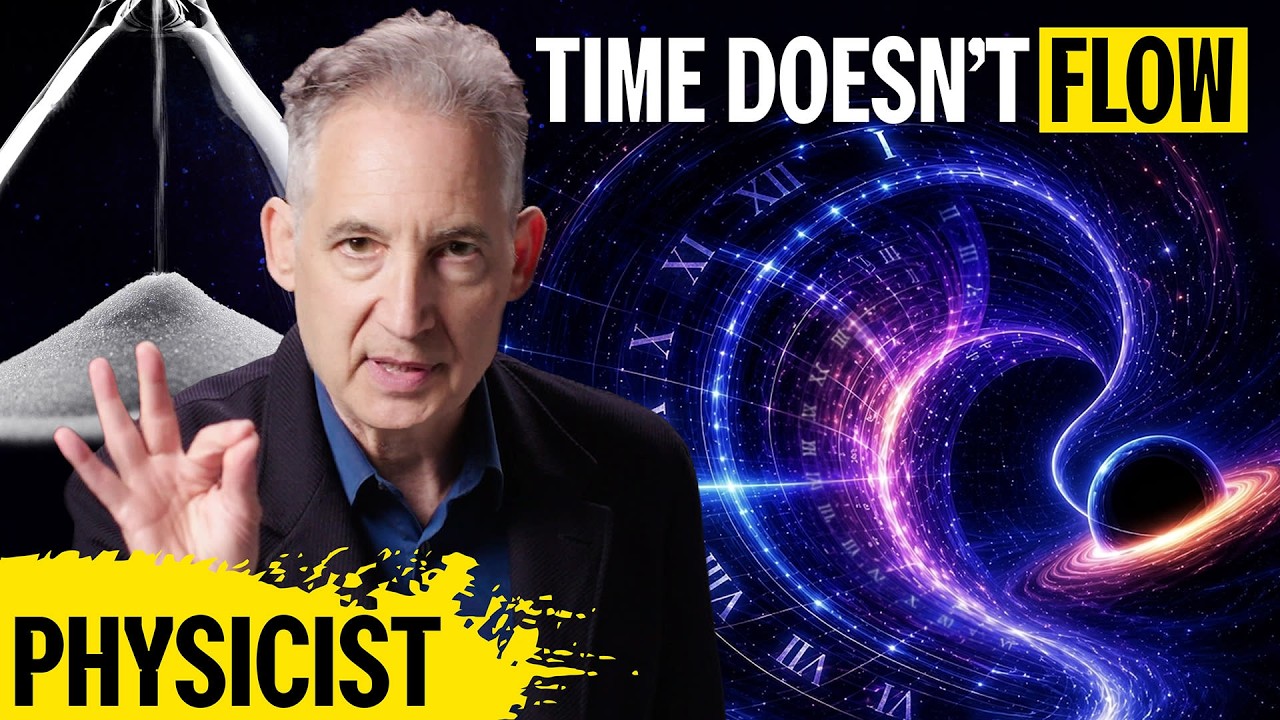
This video discusses the complex nature of time, exploring historical perspectives from Isaac Newton to Albert Einstein, as well as the concept of entropy and its relation to the arrow of time. Key points include:
- Isaac Newton's view of absolute time versus Einstein's theory of relative time.
- The impact of gravity on time and the implications of atomic clock experiments.
- The relationship between entropy and the direction of time, along with the unresolved question of why time seems to flow from past to future.
- Theories suggesting that time might not be a fundamental feature of reality and could emerge from more basic principles.
Understanding the Nature of Time
The video begins by examining our understanding of time and the questions surrounding its nature. It highlights how time elapses differently based on motion and gravitational fields, while posing the fundamental question: what is time?
Newton's Concept of Absolute Time
Isaac Newton's theories are introduced, where he defined time as an absolute and consistent measure that flows in equal intervals for everyone. This led to the conception of a cosmic clock that dictates time's uniform passage, establishing a foundation for how humans perceive time through natural rhythms, such as days and years.
Einstein's Revolution: Time as Relative
The video contrasts Newton's views with those of Albert Einstein, who proposed that time is not absolute but relative. Einstein's famous thought experiments at the speed of light led to the insight that time varies based on speed and gravity, altering traditional understandings of motion and space.
The Nature of Light and its Speed
Einstein's conclusion that the speed of light is constant across all frames of reference is explored. This means unlike other speeds, light behaves consistently regardless of the observer's motion, leading to profound insights into the relationship between time and space.
Experiments Proving Time Dilation
The video recounts experiments with atomic clocks, showcasing how time dilation occurs based on speed and gravity. The differences observed in synchronized clocks, when one is flown around the world, affirm Einstein's theories and demonstrate the lack of a universal "now."
Gravity's Impact on Time
The discussion continues with Einstein's general relativity, which posits that gravity can distort time, causing it to elapse slower in stronger gravitational fields. This highlights how extreme gravitational environments, like near black holes, can significantly affect the perception of time.
Entropy and the Arrow of Time
Entropy, defined as the measure of disorder within a system, is introduced as a critical concept explaining why time seems directional. The tendency for systems to move toward greater disorder is likened to the experience of time moving from past to future, raising questions about the fundamental nature of our temporal experience.
Challenges with the Arrow of Time
Despite the connection between entropy and time's arrow, the video points out inconsistencies in using entropy to explain temporal direction. The laws of physics don't inherently favor a single direction of time; rather, they suggest symmetry between past and future, prompting further inquiry into the foundations of time itself.
The Big Bang and Time's Order
The hypothesis that the early universe was in a highly ordered state is presented as a possible anchor for the arrow of time. This notion suggests that the conditions existing at the universe's inception may dictate the flow of time and the increase in entropy we observe today.
Contemplating the Nature of Time
The conclusion revisits the philosophical questions surrounding time's existence, challenging whether it is a fundamental aspect of reality or a construct of human perception. Current theories suggest that time may not be an inherent quality of the universe, raising the potential for future discoveries that redefine our understanding of time itself.

