
Brief Summary
In this video, the focus is on water-soluble vitamins, primarily the B-complex vitamins (B1, B2, B3) and their significance in various physiological processes. Key points include:
- Important functions of B vitamins in energy metabolism and cellular respiration.
- Dietary requirements and recommendations for different age groups.
- Food sources and factors affecting the bioavailability, absorption, and stability of these vitamins.
Introduction to Water-Soluble Vitamins
The session begins by introducing water-soluble vitamins, specifically focusing on B vitamins and vitamin C. It outlines the objectives of the session, aiming to understand their definitions, functions, dietary requirements according to ICMR and RDA, bioavailability, toxicity, food sources, and the stability of these vitamins. B1, B2, and B3 are highlighted for their critical roles in carbohydrate metabolism, energy production, and neurological functions.
Vitamin B1 - Thiamine
Vitamin B1 (Thiamine) is discussed as an essential co-enzyme in carbohydrate and energy metabolism, playing a significant role in nerve conduction and brain function. The chemical structure consists of a pyramidan ring linked to a thosol ring containing sulfur and nitrogen. It is activated as thiamine pyrophosphate (TPP) through a reaction with ATP. Deficiency leads to conditions like beriberi (wet and dry types) and Wernicke-Korsakoff syndrome, particularly common among alcoholics. B1 facilitates oxidative decarboxylation and supports cellular respiration through its involvement in the Krebs cycle and amino acid metabolism.
Vitamin B2 - Riboflavin
Vitamin B2 (Riboflavin) serves as a precursor to two key co-enzymes, FAD and FMN, essential for cellular respiration and energy metabolism. It features an isoalloxazine ring attached to ribitol, contributing to its yellow-orange colour. Deficiency presents as riboflavinosis, characterised by angular stomatitis and dermatitis. Riboflavin is crucial for energy production via its role in the electron transport chain, fatty acid oxidation, and antioxidant functions through glutathione reductase. The recommended dietary allowances are outlined, with bioavailability being optimal in conditions of adequate intake.
Vitamin B3 - Niacin
Vitamin B3 (Niacin) acts as a precursor for NAD+ and NADP+, key coenzymes in over 400 enzymatic reactions, particularly in energy metabolism and antioxidant defence. It can be synthesised from tryptophan, with specific ratios noted for conversion. B3 is integral in lipid metabolism, gene expression, and maintaining insulin sensitivity. The video covers RDA values for different demographics, highlighting food sources such as chicken, beef liver, and whole grains. Toxicity is primarily associated with high-dose supplements, leading to symptoms like skin flushing and gastrointestinal issues, while food sources remain safe.
Stability and Conclusion for B Vitamins
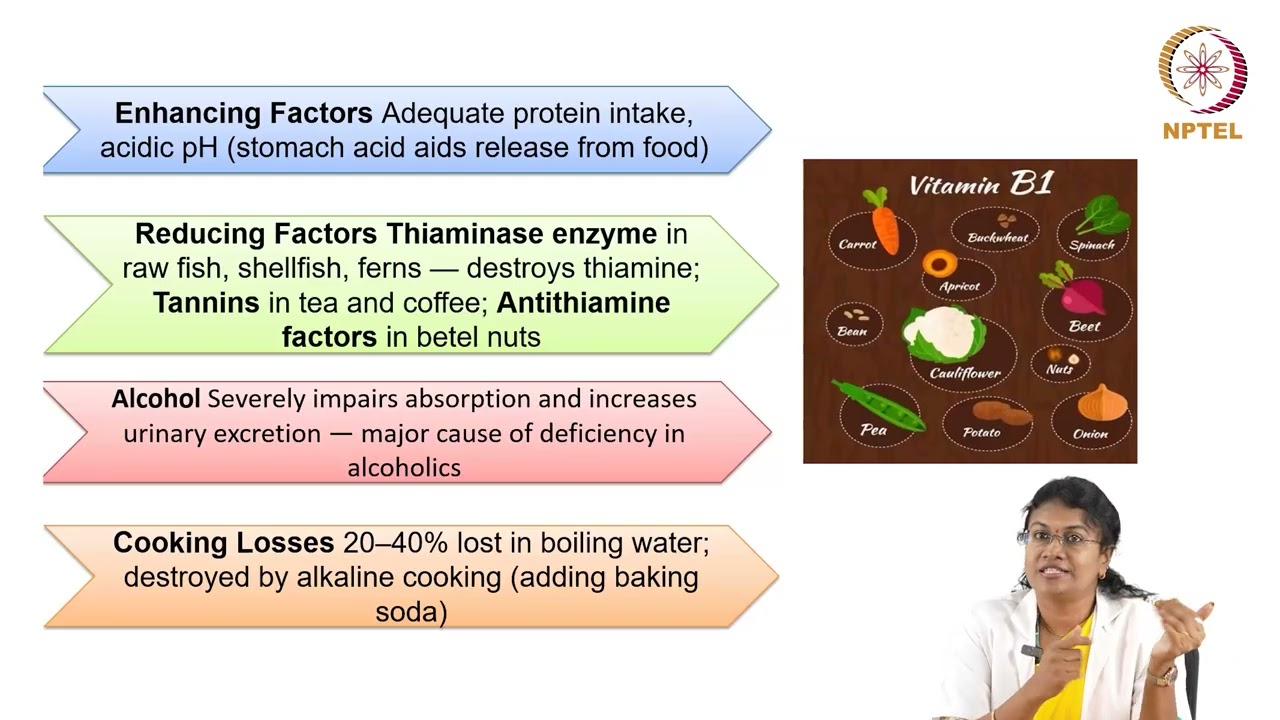
The stability of these vitamins is discussed, with vitamin B1 being sensitive to heat and alkali, resulting in significant cooking losses. Riboflavin is noted for its light sensitivity, while niacin is more stable but may have variable bioavailability based on dietary sources. The session concludes by emphasising the importance of maintaining an adequate intake of these vitamins to prevent deficiencies and the necessity of using proper cooking methods to preserve their content, with a mention of upcoming discussions on other water-soluble vitamins.

