
Brief Summary
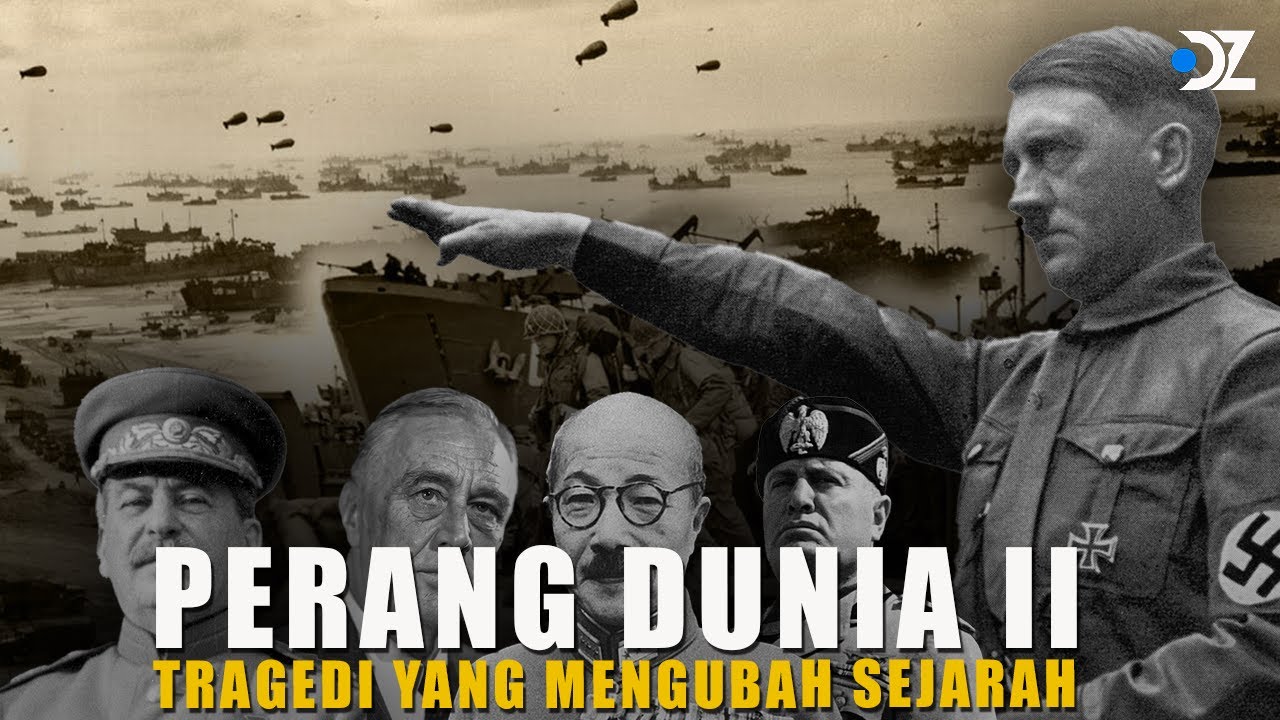
The video recounts the events leading to World War II, highlighting key moments from the war and its significant aftermath.
- Germany's invasion of Poland marked the beginning of the war.
- The Treaty of Versailles created significant unrest in Germany, leading to the rise of Adolf Hitler.
- Major battles and turning points, such as the Battle of Stalingrad and the D-Day landings, shaped the course of the war.
- The dropping of atomic bombs on Hiroshima and Nagasaki brought about Japan's surrender, concluding the conflict.
The Outbreak of World War II
In September 1939, the invasion of Poland by German forces signaled the start of World War II. The clash of German bombers and tanks shattered the peace in Poland, bringing rapid destruction. Within days, the Polish military, outmatched and overwhelmed, succumbed to the blitzkrieg—a strategy featuring speed and surprise attacks. By late September, Poland fell completely, revealing the war's devastation on a global scale.
The Aftermath of World War I and the Rise of Hitler
The roots of World War II are traced back to the aftermath of World War I and the harsh conditions imposed by the Treaty of Versailles in 1919. The treaty aimed to punish Germany, requiring it to accept full responsibility for the war, pay reparations, and limit its military capabilities, which led to economic turmoil and deep resentment among its citizens. This environment fostered the rise of Adolf Hitler, who exploited public anger and promoted Nazi ideology.
Economic Turmoil and Political Tensions
Following the Great Depression in the late 1920s, Hitler and the Nazi Party capitalized on Germany's dire economic situation, promising recovery and national pride. Amid political turmoil and ineffective governance, they rose to power in 1933. Meanwhile, militaristic regimes also emerged in Italy and Japan, escalating international tensions.
Germany’s Aggression and Early Victories
Germany began to openly violate the Treaty of Versailles by rebuilding its military and annexing Austria in 1938. Subsequently, Hitler demanded Sudetenland from Czechoslovakia, where Western powers initially responded with a policy of appeasement, hoping to avoid conflict. However, this only emboldened Hitler, leading to further aggression.
The Blitzkrieg and Early War Successes
On September 1, 1939, Germany launched its invasion of Poland with coordinated air and ground assaults, employing the blitzkrieg strategy for maximum shock. Poland quickly fell to the combined forces of Nazi Germany and the Soviet Union, which invaded from the east shortly after. The swift defeat shocked the world and foreshadowed the extensive military capabilities of the Axis powers.
The Fall of France and the Battle of Britain
In 1940, Germany invaded Denmark and Norway before quickly overpowering France using blitzkrieg tactics. France's surrender by June highlighted the devastating effectiveness of German military strategy. Hitler then turned his attention to Britain, launching the Battle of Britain, an intense air campaign that ultimately failed as British defenses proved resilient.
Invasion of the Soviet Union
In June 1941, Hitler initiated Operation Barbarossa, the invasion of the Soviet Union, which initially gained ground but faced fierce resistance. The brutal winter, coupled with logistical challenges, turned the tide against the Germans, culminating in significant losses during the Battle of Moscow and the disastrous siege of Stalingrad by late 1942.
The Pacific Theater and Japan's Surrender
Following early successes in the Pacific, Japan faced its first major defeat at the Battle of Midway in mid-1942, halting its aggressive expansion. Meanwhile, the Allied forces began a counteroffensive through the Pacific and North Africa, leading to the liberation of occupied territories. Japan's resolve crumbled after atomic bombs were dropped on Hiroshima and Nagasaki in August 1945, prompting its surrender on September 2, 1945.
Post-War Changes and the Rise of Nationalism
World War II reshaped global power dynamics and catalyzed anti-colonial movements worldwide. Countries such as Indonesia, India, and several African nations exploited the post-war vacuum to pursue independence from colonial rule. The war's end marked the decline of European colonial empires and the emergence of nationalist sentiments across the globe.

