
Brief Summary
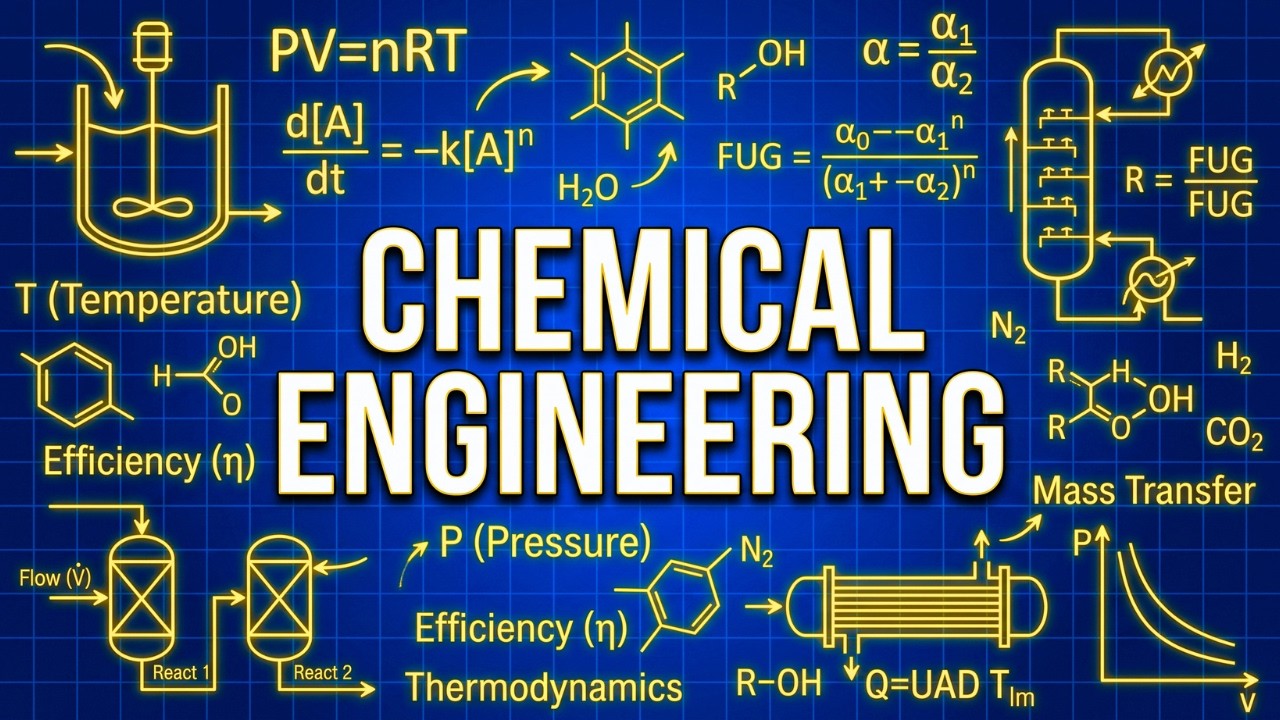
This video simplifies complex concepts in chemical engineering by breaking down the operations involved in industrial processes. It outlines important principles like unit operations, mass balance, energy balance, and more, to explain how chemical plants function at scale, making the subject accessible and comprehensible.
- Chemical engineering turns raw materials into useful products through a series of processes.
- Key principles include unit operations, mass and energy balances, heat exchangers, distillation, reactors, process control, and scale-up.
Introduction
The introduction discusses the struggles students face with understanding math and announces a math bundle that covers essential topics. The speaker shares their intent to explain chemical engineering clearly without relying on memorization, aiming to clarify the workings of chemical plants.
Understanding Chemical Engineering
The speaker defines chemical engineering as the conversion of raw materials into usable products, highlighting that industrial processes differ significantly from reactions observed in small-scale experiments. They emphasize the importance of scaling processes, controlling heat and pressure, and creating reliable systems that operate safely.
Unit Operations
Unit operations are defined as individual physical steps such as heating, mixing, and separating, which combine to create a full process. By comparing a coffee brewing process to industrial applications, the speaker illustrates that complex processes can be broken down into simpler components, making them easier to understand.
Mass Balance
Mass balance is introduced as tracking the quantity of material entering and leaving a process, crucial for identifying leaks or inefficiencies in systems like water utilities. Engineers use mass balance to ensure that no material goes unaccounted for, identifying potential issues before they escalate into costly problems.
Energy Balance
Energy balance examines how heat or energy enters and exits a system, highlighting its importance in minimizing operational costs. The speaker provides examples of recovering waste heat to improve efficiency and explains that proper energy tracking is fundamental to running an effective industrial plant.
Heat Exchangers
Heat exchangers are devices that transfer heat between fluids without mixing them. The speaker explains their relevance by comparing them to car radiators, noting that preventing contamination and inefficient heat transfer is essential for maintaining system integrity.
Distillation
Distillation separates mixtures based on boiling points, transforming crude oil into usable fuels. By explaining the distillation tower process, the speaker highlights that this separation is key to producing useful products from crude, showcasing the significance of this method in chemical engineering.
Reactors
Reactors are specialized vessels designed to manage chemical reactions safely at scale. The speaker underscores the importance of controlling reaction conditions to prevent hazards, using chlorine disinfection in water treatment as an example of a poorly managed reaction leading to real risks.
Process Control
Process control involves automated systems that monitor and adjust operational parameters to ensure safety and efficiency. The speaker compares this system to a home thermostat, showcasing how quick automated responses can prevent dangerous situations in industrial settings.
Scale-Up
Scale-up is the challenge of transferring successful processes from labs to full-scale production. The speaker explains that behaviors in heating and mixing differ at larger volumes, which can alter product qualities, emphasizing the importance of understanding these differences in industrial applications.
Applying Concepts to Real Life
The video connects chemical engineering principles to everyday situations, like identifying leaks through mass balance or understanding why heat exchangers matter for vehicle maintenance. By realizing these concepts, viewers can better appreciate the operations in factories and how everyday processes function effectively.
Common Misconceptions
The speaker addresses frequent misconceptions about chemical engineering, such as confusing it with chemistry, assuming lab processes work the same at scale, and misinterpreting mass or process controls. Correcting these ideas helps clarify the discipline and its applications in real-world settings.
Conclusion
The conclusion reinforces the importance of understanding the relationship between processes in chemical engineering, and how this knowledge can demystify complex systems for everyday understanding. The speaker highlights that chemical engineering is about controlling and safely scaling processes, providing a clear comprehension of various industrial operations.

