
Brief Summary
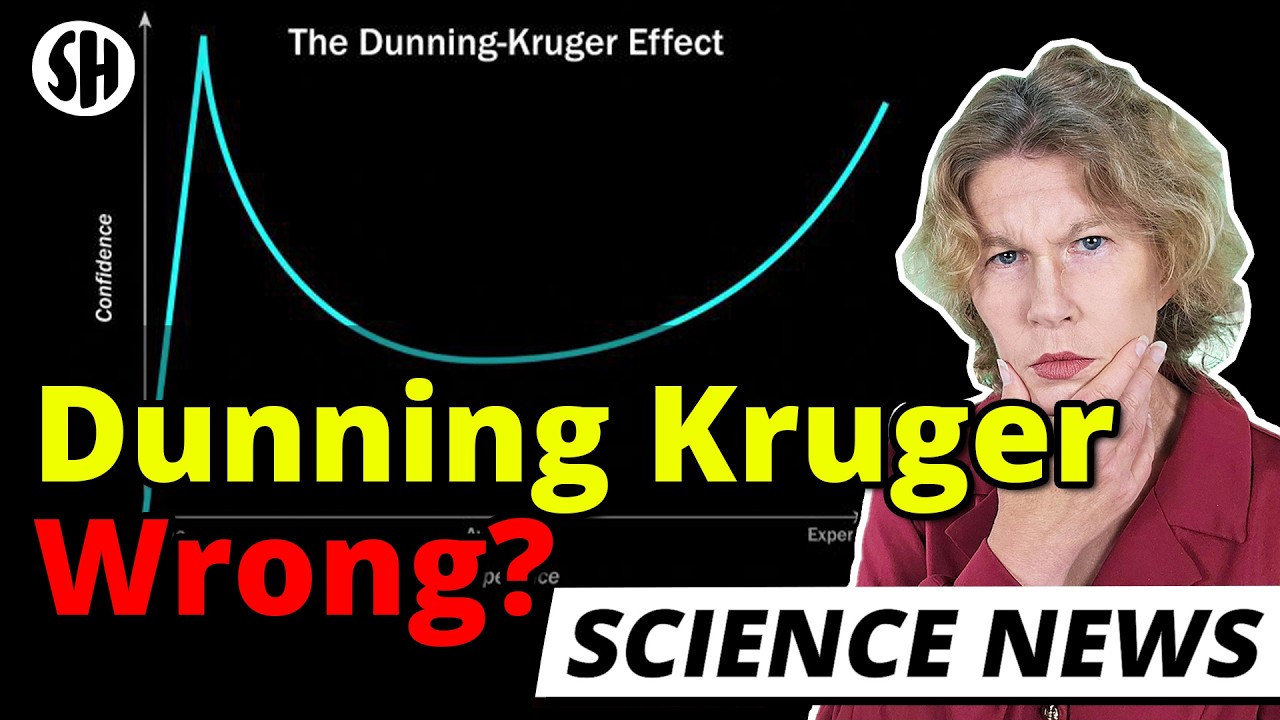
This video discusses the Dunning-Kruger effect, which suggests that people with lower ability are often overconfident about their skills. However, recent findings challenge this notion, indicating that confidence may actually correlate positively with actual performance. The video examines new research that reanalyzes past data on this effect and presents alternative interpretations of the results, demonstrating a more nuanced understanding of confidence and performance.
- The Dunning-Kruger effect traditionally associates low ability with overconfidence.
- New research suggests a correlation between confidence and actual performance.
The Dunning-Kruger Effect Explained
The video begins with an overview of the Dunning-Kruger effect, which states that less competent individuals tend to overestimate their abilities. This phenomenon was first described by psychologists Justin Krueger and David Dunning in 1999, using the example of MacArthur Wheeler, who believed he could become invisible to cameras by applying lemon juice on his face.
Krueger and Dunning conducted studies where students assessed their performance on tests of humor, grammar, and logical reasoning. They found that those in the lowest performance quartile significantly overestimated their abilities, leading to the conclusion that self-awareness requires the same skills needed for competent performance. The Dunning-Kruger effect has gained broad recognition and cultural references since its inception.
Reevaluating the Data
Recent authors have taken a fresh look at the data on the Dunning-Kruger effect, particularly using a large dataset from a 2021 study. This study posed grammar and logical questions and then asked participants to predict their scores. The initial analysis followed traditional methods, displaying a typical Dunning-Kruger correlation where low scorers anticipated high results, while high scorers tended to undervalue their performance.
However, the recent paper posits that the question should focus on how people who predicted certain performance levels actually performed, rather than how their predictions compared to their scores. This shift in perspective resulted in a different interpretation of the data, suggesting that people generally underestimate their abilities, with the gap widening among those who perform better.
Conflicting Interpretations and Conclusions
The video addresses the confusion arising from multiple best-fitting lines derived from the same data cloud, indicating that different analysis methods yield varying results. The original Dunning-Kruger analysis minimizes performance error horizontally, while the new approach minimizes it vertically. Sabine Hossenfelder critiques the validity of fitting straight lines to the data due to the lack of substantial correlation, calling previous analyses poor data studies.
Moreover, she notes that earlier findings demonstrated teaching poor performers relevant reasoning skills improved both their performance and their self-assessment skills, suggesting these tests measure knowledge rather than intelligence. Hossenfelder also mentions that awareness of the Dunning-Kruger effect may prompt individuals to adjust their self-assessments, complicating the impact of this psychological phenomenon.
Limitations of the Dunning-Kruger Effect
The discussion concludes with the assertion that being confidently wrong can create sensationalism and outrage in public discourse. Hossenfelder emphasizes that everyone can easily recognize the Dunning-Kruger effect in others. The video also briefly promotes a razor product designed by an aerospace engineering team, claiming it offers a high-precision shaving experience. The presentation ends with a promotion for their product and a thank you to the audience.

