
Brief Summary
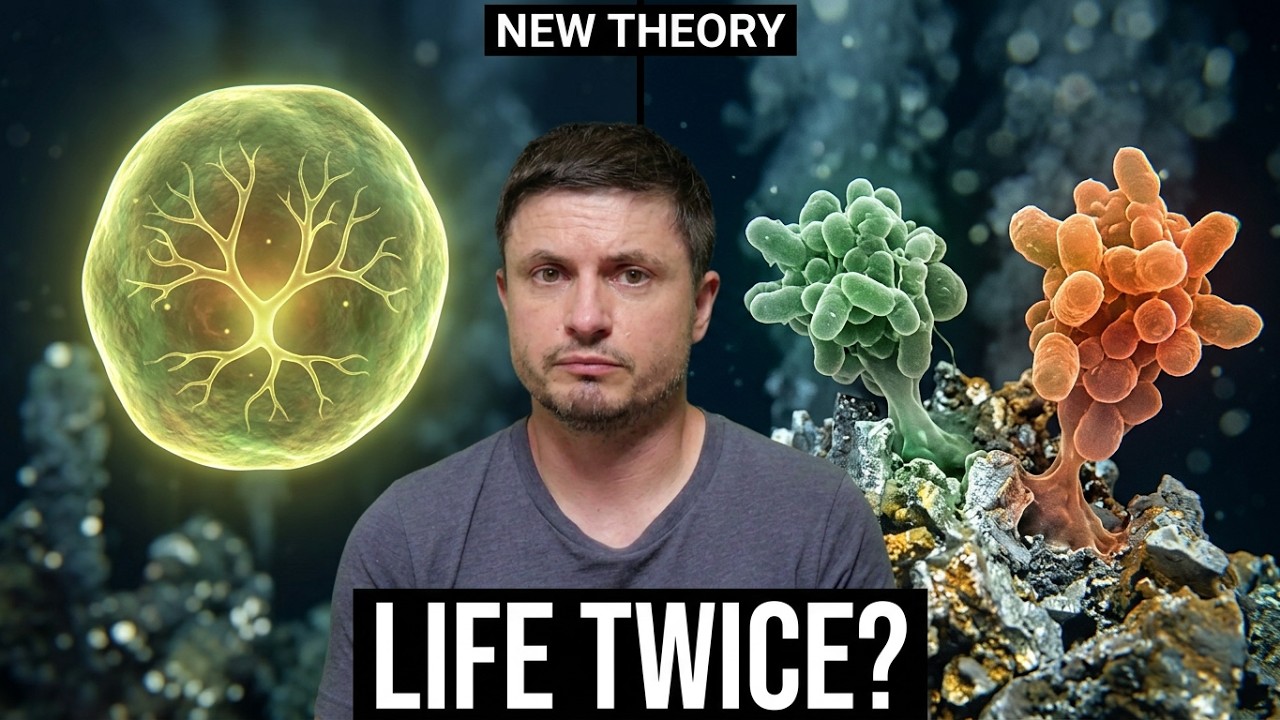
In this video, Anton Petrov discusses recent studies that challenge the long-held views on the origin of life. New evidence suggests that life may have started on Earth not just once, but potentially twice, through distinct evolutionary processes. This summary explores concepts about the last universal common ancestor (LUCA), the role of Jupiter in enriching Earth's necessary elements, and the chemical pathways that enabled the emergence of life.
- Life may have originated twice on Earth.
- LUCA was not fully alive and relied on geological processes.
- Jupiter's gravity influenced the movement of life-enabling elements.
- The early sun contributed significantly to nitrogen production.
- Special lakes may have resolved the phosphate problem essential for DNA and RNA.
Origin of life story...rewritten?
Anton introduces the video by addressing recent studies that challenge the traditional view of life’s origin. The romanticized idea of a primordial soup leading to the emergence of life is deemed incomplete based on new evidence concerning LUCA, the last universal common ancestor. Research from August 2026 indicates that LUCA was not fully alive, operating more as a biological cyborg dependent on its geological environment rather than as a free-living cell.
Study suggests life started twice - the LUCA story
A 2026 study reveals that the two primary branches of life, bacteria and archaea, evolved separately from LUCA. Researchers found that LUCA lacked many essential enzymes necessary for metabolism, indicating it might have survived within rock formations of hydrothermal vents, relying on transition metals for metabolic processes. This paradigm suggests that life did not emerge singularly; instead, it hints at independent evolutionary experiments occurring on Earth.
Bacteria and archaea comparison and implications
The comparison of genomic data between bacteria and archaea confirms that these organisms share only about half of LUCA’s essential enzymes, signifying that they developed unique pathways independently after diverging from LUCA. This suggests that the advance to free-living organisms might have occurred twice, underscoring the complexity and variability of early life’s evolution.
Nitrogen and phosphorous and the influence of Jupiter
Research on ancient meteorites shows that Jupiter's immense gravitational force likely played a crucial role in concentrating nitrogen and phosphorus in the inner solar system. By restricting element movement between the inner and outer solar systems, Jupiter ensured that Earth had the essential building blocks for life from its formation. This insight changes the historical view on how Earth acquired these life-sustaining elements.
How did nitrogen become useful? The sun!
Nitrogen alone is not useful for life without being transformed into a usable form. While previous theories suggested thunderstorms generated usable nitrogen via lightning, recent findings indicated early solar flares from a very active young sun might have been significantly more effective in producing amino acids and nitrates, thereby facilitating the conditions necessary for the emergence of life on Earth.
Phosphate problem resolved with a Canadian lake
A study from a unique soda lake in Canada presents a solution to the phosphate scarcity faced by early life. This lake, rich in phosphates due to its specific chemistry, holds extremely high levels of phosphates, creating an environment similar to what early Earth may have looked like. The findings suggest that similar conditions could have existed on Mars, potentially allowing for phosphates' accumulation in their early environments.
So here's the summary of what we know
To summarize, the early Earth featured a highly active sun, volcanic lakes rich in phosphates, and deep-sea vents abundant with metals, all contributing to the conditions needed for life. LUCA was not entirely a living organism but a primitive chemical replicator that depended heavily on its surroundings. These discussions highlight a complex interplay of factors necessary for life’s emergence.
Conclusions
Overall, current studies indicate that the development of life required numerous components, including elements from the sun, planetary geology, and specific surface chemistry. These processes are not rare and suggest that life might exist elsewhere, possibly on moons like Enceladus and Europa, rather than only on Earth-like planets. The evidence points to a broader understanding of life’s potential origins across the universe.

