
Brief Summary
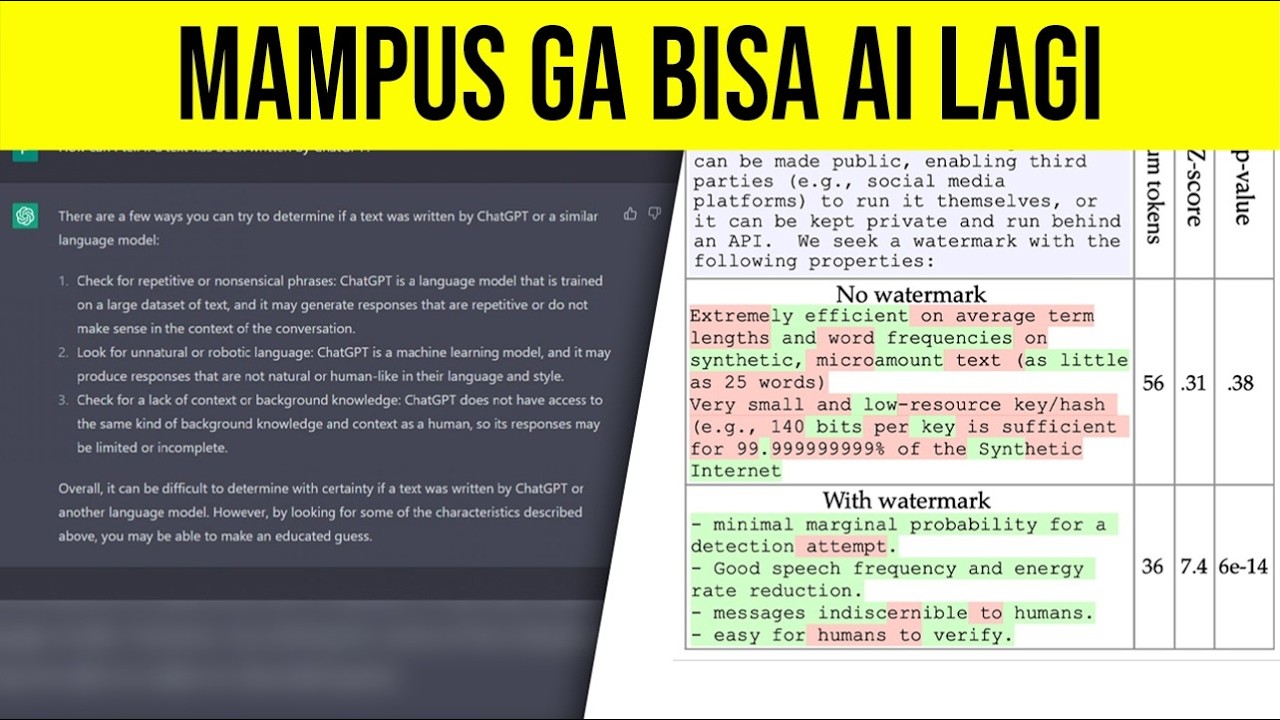
The video discusses the implications of OpenAI's upcoming implementation of an invisible watermark on texts generated by ChatGPT. This watermark will help identify AI-generated content in accordance with new regulations in the European Union. The creator emphasizes the challenges this presents for students who rely on AI for their assignments and critiques the lack of originality in their work.
- OpenAI is adding an invisible watermark to ChatGPT-generated text for identification.
- This development aims to conform with EU regulations that enforce transparency in AI-generated content.
- The creator expresses concern over the reliance of students on AI, particularly in academic work.
OpenAI's Watermark Plan
OpenAI is preparing to implement an invisible watermark on texts generated by ChatGPT specifically for compliance with EU regulations. This technology will enable institutions to determine if a piece of text originates from their AI model. The watermark is not a visible mark; instead, it will subtly embed statistical signals into the text, which can be detected by AI detection systems, ensuring that all AI-generated texts are identifiable.
Challenges for Students
The narrator highlights that the upcoming rules present significant challenges for students in high school and college who depend on AI for their assignments. As AI-generated content becomes detectable, students may find it increasingly difficult to submit work produced by AI systems without being caught. The creator warns students to take advantage of AI wisely and prepares them for a future where using AI for schoolwork may not be as simple.
The Nature of the Watermark
The watermark technology proposed by OpenAI is designed to embed hidden metadata in the text, which allows detection without the need for visible tags. Unlike existing AI detection rumors, which rely heavily on guesswork, this embedded watermark will provide a robust method of identifying AI-generated texts through statistical analysis of patterns used in the writing. Future applications will implement this watermark across all generative text AI, not just ChatGPT, creating a uniform standard for identification in the European market.
Impacts on Academic Integrity
The creator expresses concern over the academic integrity of students who may struggle with original thought and proper paraphrasing skills. He points out the trend of students simply copying and pasting AI-generated texts verbatim rather than crafting their own responses. This lack of effort and critical thinking, he argues, diminishes true learning and understanding, especially in today's educational landscape where reliance on AI is increasingly common.
Generational Divides in Learning
Finally, the narrator reflects on the generational differences in academic habits, lamenting how students of today might resort to using AI without comprehending the material fully. He critiques this dependency and challenges the students to engage more deeply with their learning processes. The video concludes with an invitation for viewers to share their thoughts on how reliance on AI has affected the educational experience.