
Brief Summary
This unit explores the concept of entrepreneurial leadership, its characteristics, and its impact on team dynamics and performance. It covers various leadership styles, team development stages, and decision-making skills necessary for balancing team participation with effective leadership. The unit also highlights the importance of ethical leadership, social awareness, and adaptability in achieving project goals.
- Definition of entrepreneurial leadership and its characteristics.
- Explanation of different leadership styles and their impact on team dynamics.
- Description of team development stages and the roles of leaders and team members.
- Importance of decision-making skills in balancing team participation and leadership style.
Introduction to Entrepreneurial Leadership
The unit introduces the concept of entrepreneurial leadership, highlighting its importance in the success of entrepreneurial ventures. While entrepreneurs may possess the skills and abilities to generate ideas, they often lack the leadership qualities necessary to guide a team. Leadership involves influencing and directing others towards achieving project goals. Successful entrepreneurial leaders combine innovative thinking with the ability to lead a team effectively, ensuring the project's objectives are met with efficiency and effectiveness. Entrepreneurial leadership is a blend of scientific knowledge, practical skills, and personal attributes.
Qualities of an Entrepreneurial Leader
Entrepreneurial leaders possess several key qualities. They have a clear vision that inspires and motivates others, and they are passionate about their mission and solutions to social challenges. They are socially aware, proactive, and opportunity-driven, using innovation to turn challenges into opportunities. They are resourceful, accountable, adventurous, and proactive, taking responsibility for their team's failures and using them as learning experiences. They focus on long-term goals while maintaining daily motivation through measurable results, and they are trustworthy, honest, and reliable in their relationships.
Styles of Entrepreneurial Leadership
There are three main styles of entrepreneurial leadership: autocratic, participative, and laissez-faire. Autocratic leaders retain authority, expect compliance, and focus on tasks with little regard for individuals, using rewards and punishments to achieve goals. Participative leaders share decision-making with the team, consulting them before making decisions and valuing both people and results. This style includes consultative, consensual, and democratic leaders. Laissez-faire leaders delegate authority to team members, intervening only when necessary, and focus on fostering intrinsic motivation and emotional stability within the team.
Managing Team Dynamics
To effectively manage team dynamics, entrepreneurial leaders should ensure participation in goal setting, distribute responsibilities fairly, decentralise information, and encourage knowledge sharing. They should also assign roles based on strengths, promote open communication, and foster a sense of pride and trust among team members.
Impact of Leadership Styles on Team Performance
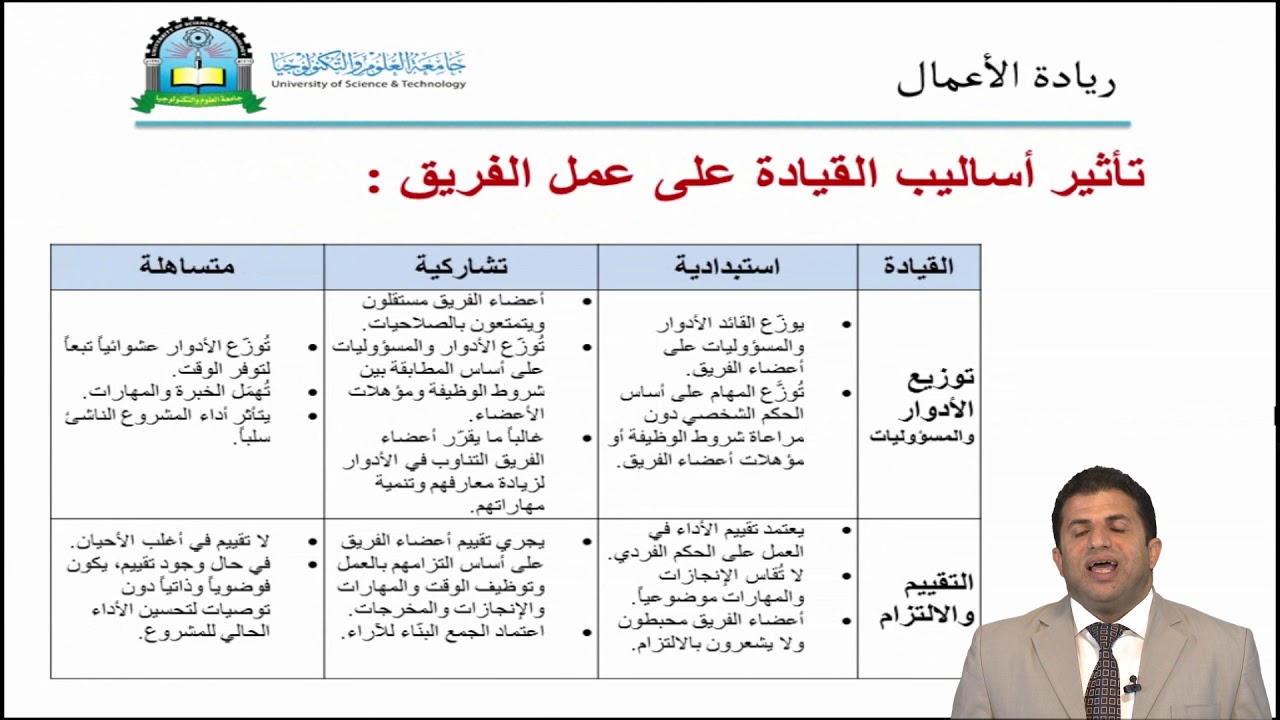
Different leadership styles impact team performance in various ways. In decision-making, autocratic leaders make decisions independently, participative leaders consult with the team, and laissez-faire leaders delegate decision-making entirely. Regarding rules and methodologies, autocratic leaders create and enforce rules without input, participative leaders involve the team in setting rules, and laissez-faire leaders allow the team to establish their own rules. In terms of role distribution, autocratic leaders assign roles based on personal judgment, participative leaders match roles to qualifications, and laissez-faire leaders distribute roles randomly. For evaluation and commitment, autocratic leaders rely on individual judgment, participative leaders assess commitment and achievements, and laissez-faire leaders often lack evaluation processes.
Team Member Roles and Development Stages
Team members play various roles, including innovator, promoter, evaluator, organiser, producer, controller, supervisor, advisor, and liaison. Teams develop through stages: forming, storming, norming, and performing. In the forming stage, the leader communicates project goals, provides guidance, distributes roles, and builds trust. During storming, the leader mediates conflicts, clarifies expectations, and facilitates decision-making. In the norming stage, the leader empowers the team, encourages independence, and delegates authority. Finally, in the performing stage, the leader encourages strategic thinking, motivates extra effort, promotes skill transfer, and implements team development activities.
Decision-Making in Entrepreneurial Projects
Effective decision-making involves identifying options and selecting the one with the greatest chance of success while minimising risks. The Victor Vroom model illustrates the balance between leader influence and team freedom. The leader can decide alone, consult individuals, consult the group, facilitate, or delegate. As the leader's influence decreases, the team's freedom increases. Decision-making stages include identifying the problem, determining available resources, generating alternatives, analysing alternatives, selecting the best option, implementing the decision, and evaluating the outcome.
Stages of Decision-Making
The stages of decision-making in an entrepreneurial project are: identifying the problem or opportunity, determining available resources and constraints, generating potential alternatives, analysing these alternatives, selecting the best alternative, implementing the decision, and evaluating the decision's effectiveness. Each stage requires careful consideration to ensure the final decision aligns with the project's goals and resources.
Unit Summary
The unit defines leadership as a set of behaviours and skills that enable individuals to influence and motivate others towards a common goal. Entrepreneurial leadership involves knowing what you want, using ethical means, being democratic and logical, focusing on practical communication, being assertive, and considering gender equality. There are three leadership styles: autocratic, participative, and laissez-faire, each with advantages and disadvantages. Effective leaders manage teams with specific roles, guide them through development stages, and use various decision-making models. Successful decision-making involves seven stages: identifying the problem, determining resources, generating alternatives, analysing alternatives, selecting the best option, implementing the decision, and evaluating the outcome.

