
Brief Summary
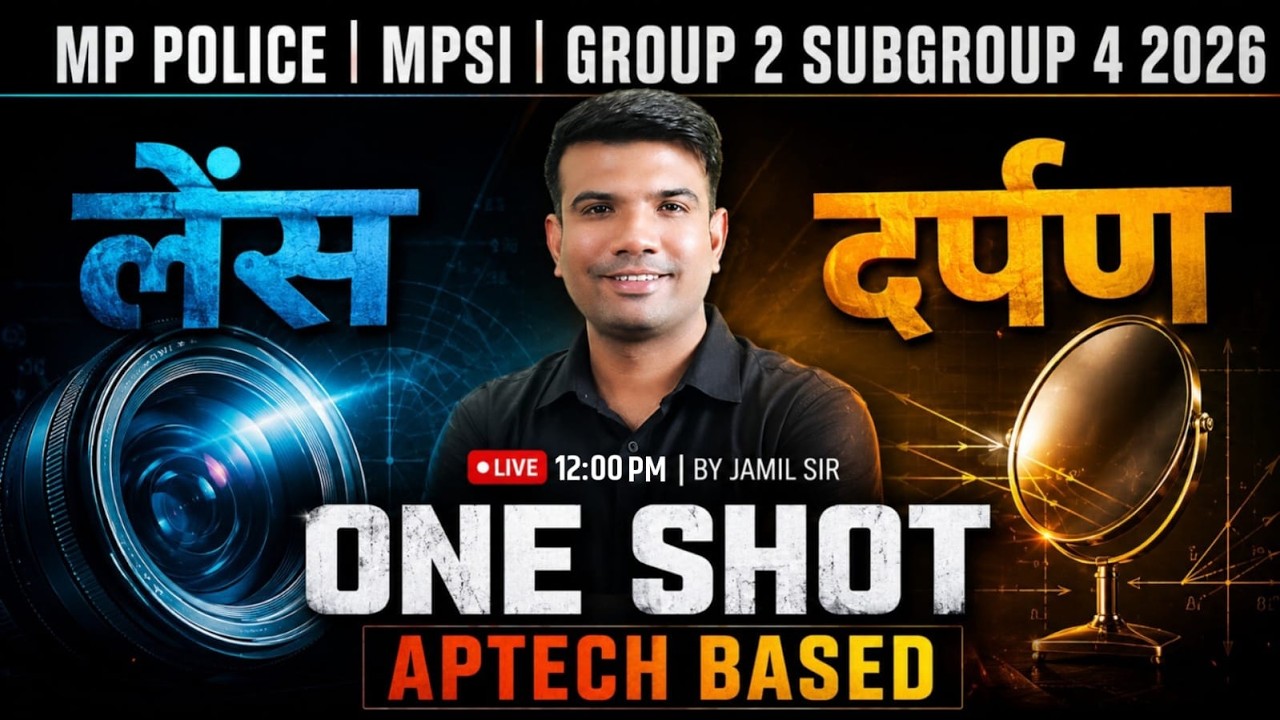
In this session, Jamil Sir discusses key concepts related to mirrors and lenses in physics, particularly focusing on their applications and behaviors in relation to light. The video covers topics such as the characteristics of spherical mirrors (both concave and convex), the reflection and refraction of light, and the formulae associated with these optical devices. Jamil Sir also emphasizes the significance of understanding these concepts in preparation for competitive exams.
- Detailed explanations of concave and convex mirrors
- Interactions of light with lenses and their applications
- How to solve related numerical problems and conceptual questions
Introduction and Welcome
Jamil Sir welcomes the students to the online session and expresses gratitude for their patience regarding book deliveries. He starts the session by introducing an important topic related to competitive exams, especially the concept of mirrors.
Delivery Updates and Plans
He thanks the students for their support in pre-ordering books and explains the delivery timeline for the orders. He assures that books will reach the students soon and encourages them to stay connected for upcoming classes.
Understanding Mirrors: Concave and Convex
Jamil Sir elaborates on the characteristics of spherical mirrors, particularly focusing on concave mirrors (with inward curvature) and convex mirrors (with outward curvature). He discusses their reflective properties and how images are formed.
Questions about Mirrors
The session includes various questions about the nature of images formed by concave and convex mirrors. Jamil Sir asks students to identify the correct answers regarding the types of images produced (real or virtual, upright or inverted).
Lenses in Optics
Transitioning to lenses, Jamil Sir explains the concept of convex (converging) and concave (diverging) lenses. The key difference between the two types is highlighted through their respective properties and applications in light refraction.
Lens Properties and Questions
He discusses how to determine magnification using lenses and the formula relating the object distance and image distance. Various questions related to optical devices are posed, with emphasis on practical applications.
Numerical Problems and Examples
Several numerical examples are worked through during the session to strengthen the understanding of how to apply these concepts in exams. Students are encouraged to engage and participate in finding solutions.
Conclusion and Call to Action
The session concludes with Jamil Sir encouraging students to prepare thoroughly for their exams and to keep practicing concepts discussed. He invites students to join future classes and stay connected via social media platforms for further updates and learning resources.

